Tuesday, January 10, 2012

Pondering India

He pours the beers precisely, like wine, but in a frosty pint glass, only one quarter full. Its as if he wants us to taste and approve before he pours more. He sets the beer, label facing us to show the snowy flat peak of Kilimanjaro, passport photo of a giraffe in a circle below it, next to the glass on matching red Castle coasters, side by side. He does this three times. One for Annette. One for Mara. One for me.

He tests this capless black pen with which I write before he loans it to me. As I write, I wonder where the cap is. In the basket under a cloth napkin behind the bar from where the pen first presented itself before my eyes? Or perhaps it has its own passport photo, like the beer's giraffe, that allows it to cross borders to Kenya, Calcutta, Kathmandu, Koh Chang, California. Maybe the pen is counting on me to reunite it with its lover. Carry it like a barnacle on a whale a million miles to its destiny.

I just finished a book that was carried many miles to mine—Beatrice and Virgil by Yann Martel. I expected it to be good travel reading to get my mind India-ready, like Life of Pi. I saw it in a two-story bookstore that had three shelves of English titles back in Basque Country. In San Sebastian it was competing with artistic spreads of pintxos for my attention. It lost. Like the probably fate of this capless pen, it was picked up for a moment before being returned to its station. Left behind. Stuck in one small corner of the universe, not to travel beyond. Not this time.

While it traveled many miles to my eyes, Beatrice and Virgil turned out not to be a travel book at all. Only travel reading in that it was read by a traveler at a time when a piece of that home of all homes called family journeyed to another continent to meet him. Surely, the book was just an unknowing barnacle in it all. Unaware of the whale's migration. Just as we humans live mostly unaware of the earth's rotation. Unaware that our planetary home is hurling through space. The book turned out to be about the Holocaust with animals talking under a tree like they were the animated pets of Samuel Beckett. About the Holocaust, and horror, and humanity, and writing, and art. Enough to make me fetch a pen from behind a beachside bar and express myself on paper. It's a far cry from my last beach book-The Aleph. Paulo Coehlo writes the stories of his journeys in epic terms with the simplicity of a number two pencil whose previous life was confined to filling in ovals. Yann Martel writes his in humble terms with a calligrapher's quill and pen. Each elicits different inspirations and emotions. Both set me to writing.

But my mind has mostly been on Lonely Planet's India, which is entertainingly written for a guidebook. The country seems utterly indigestible. Feels like I need a wall-sized map to begin to chart a course across it. But I do what I usually do. Make some highlights, mental notes, a few physical ones, and trust that the path will reveal itself when we get there. Surely a stream doesn't trouble itself and get into a froth because a waterfall is ahead. But despite my most Taoist of efforts, I am still not a stream. Just a traveler puzzling my way excitedly through our next continent, toes in the white sands of Zanzibar

Swimming with Dolphins

We came to Zanzibar with a mental to-do list. Monkeys. Dolphins. Beaches. Spices. Stone Town. We sat at breakfast talking with Tim this morning. He's from Hamburg. Worked with Price Waterhouse Cooper. Quit his job. Decided to travel. Ended up volunteering in Rwanda through Accounting for International Development. It connects volunteer accountants with NGOs and community development groups in the developing world. For a few weeks or months, they build local financial capacity. Help them better keep track of the money so they can be responsible stewards of donations and attract more.

We told Tim we want to go to Kizimkaze today to swim with the dolphins. He responds by relaying a story about his encounter with dolphins in some lagoon on an island near Australia. He dismisses the whole experience as cliché. Cliché? I have never done it before. And until Zanzibar, I don't think I ever uttered that combination of words in my life.

We catch a crowded dalla dalla (crowded dalla dalla, now that is cliché!) from Bwejuu to Kitogani. Then we try to hitch the 22 km to Kizimkaze. We try for twenty minutes with no luck until a man in a truck pulls up. Annette sits in front and chats him up. Mara and I are in the bed. Thanks no doubt to Annette's amiability, he drives us all the way to the sand on the beach of Dolphin Village in Kizimkaze. If he drove any further, we would have been covered in salt water, sinking in white sand.

Within a matter of minutes, we have it all arranged—boat, snorkeling gear, and lunch when we return. The boat is called Nungwi and we are the only three. We motor for twenty minutes. Our captain stops to ask a fisherman in Swahili where they last saw the dolphins. We motor more. Another fisherman points the opposite direction. But we continue straight.

“At least its not like the monkeys, where they are just off the road waiting for you,” Annette says. “At least you have to find the dolphins.” We look for another half hour in silence, only interrupted by the steady sound of the motor and the occasional splashing of the prow against a wave. We pass a rocky uninhabited island. The waves splash against its cliffs. It looks like a battleship silhouetted against the blue sky and sea. After another twenty minutes, we turn back. As we speed back we continue to scan the horizon. Every white cap, every shimmer of a wave reflecting in the sun, every boat on the horizon seems to be the dorsal fin of a dolphin. But none are. The water below changes from patches of bright turquoise to dark blue, sometimes mirroring the sky, sometimes revealing whats below. Or at least hinting at it.

I ask where there is good snorkeling, settling myself in for the consolation prize. The captain points ahead with a limp finger. We ride back towards our departure point for another fifteen minutes. “How big do you think that fuel tank is?” Annette asks. “Ten or fifteen liters.” “Fuel is about 2,000 a liter,” she calculates. “If we don't see dolphins, let's offer them 20,000 for the trip.” This is half of what we negotiated up front. But on the optimism of the shore, there was no talk of not seeing dolphins. I nod, annoyed that she initiated this conversation within earshot of the captain. I suppose somehow it will reduce our negotiating power later. As we continue back toward the dolphin village, I ask again, “Where is the good snorkeling?” I want to be sure my hint is clear.

Soon enough, we slow down and start to circle. The water below looks dark. There is some discussion in kiSwahili and pointing between our captain and his mate. We circle some more before he cuts the motor off. I ease my flippers into the water, slide on my mask, stick the breathing tube in my mouth. I swim away from the boat. Below me is mostly grass. I see a piece of coral with a few small fish swimming around it. I come up for air and to see if perhaps I am swimming in the wrong place. “How's the snorkeling?” shouts the captain. “Aeeah,” I respond, rotating my hand, “so so.”

“Come back in the boat,” he responds. I snorkel my way there, hand him my flippers, then my mask. Then climb the three-rung iron ladder into the boat. We speed off to another snorkeling spot. I splash in eagerly. I immediately see more coral and more fish. I pop my head above the water and give a thumbs up back in the direction of the boat. Annette and Mara follow into the water.

Below us, another world emerges. Coral with every possible fish to match. I come across a pizza-sized ray on the bottom before Mara beckons me her direction. There she points out a long pike-like fish swimming vertically. Then Annette calls me to see another fish—black, yellow and white-striped with a huge spine on top. I notice three fish that look like the grass on the bottom—broad, green with a hint of yellow. Then a huge Nemo-like fish swims under a piece of coral. Its markings are orange, turquoise and white. Then beautiful blue and yellow fish. I look up to find small fish swimming almost within reach. But I reach out my hand to find it doesn't reach as far as I expect down here. For a moment, I just float and breathe and look. For an eternity. It is an enchanting world down here. Like the one King Arthur discovered when Merlin turned him into a pike. Magic must be at work here.

I hear a faint interruption. Above the water I find our captain calling us back to the boat. I can't hear what he is saying, but I recognize his motions. I double-check with Mara. She confirms he wants us to swim to the boat. The three of us snorkel reluctantly that direction. I am last. I don't want to leave this world. None of us do.

But as I climb into the boat, I hear talk of dolphins. So we speed that direction. Sure enough, we see several dorsal fins sticking a foot or so our of the water. They are pointier than I expected. Then they disappear for a long time. They emerge again, three dorsal fins at a time. They seem to almost be bobbing up and down from the view. Again, the boat speeds ahead. Then it stops. The captain tells us to get in the water. So we scramble overboard. I look down to find nothing. No coral. No fish. No dolphins. Just an endless blue haze. I come up, look at Mara. She looks as puzzled as I am. “Look down,” the captain shouts. “Keep looking down.” Still nothing.

Then like out of a dream emerge the dolphins. Its more than three. Maybe six or eight or ten. They swim close together, not even a body length apart. They swim maybe ten feet from us. I follow them, looking up occasionally only to ensure I am not about to collide with our boat's motor. I notice one of the dolphins in the back has a flash of white teeth. Looks like an underbite. I swim fast behind them until they disappear back into the blue, slowly fading from sight. We swim back to the boat, clumsily clamor in and speed ahead again.

This time the dolphins are no more than ten meters behind us on a direct course for the boat when we jump into the water. I look down. They come right underneath us. I could touch them if I wanted to. There are fifteen of them in all. Annette counts them. I can't count past eight. I get too excited. I watch as they surface two or three at a time. They swim in a wave pattern. Several go up. Others down. Others cresting. Each following the one in front. They are beautiful. I swim above them, kicking and paddling vigorously. They move effortlessly, with just an occasional flip of their tail. Like a flock of ibises coasting on the wind. I feel the water rushing past my face as I try to keep up. I get a mouthful of water through my snorkel. I swim with them for an hour of a minute. Then they disappear again. I manage to make it back into the boat without taking my flippers off. We do the whole thing again. I bump into Mara this time as the dolphins swim by. Now there is a second and third boat following. On the third go, I say a silent thanks and goodbye to the dolphins. We are all exhausted and satisfied.

Saturday, January 7, 2012

The Breaking Point

Goals aren't important. At least not in any cosmic sort of way. But they do make life interesting. They give it structure. And what game doesn't have goals, or points, or some equivalent? And I love games. So I am a goal setter, if for no other reason, to play games with myself regularly. Sometimes goals just pesker you forward until acheived. We spent the morning hitchhiking to Jozani Forest for walks among majestic trees and close up looks at red colobus monkeys indigineous to the island. The monkeys ham it up for the camera. They have good agents and PR people it seems. Maybe that is what all the rangers and staff sitting around actually do. Because these monkeys are definitely camera trained.

We return to Bwejuu Beach to find the wave line calling. So I recruit my sister as my first mate and we carry the two-person yellow inflatable kayak the 100 meters to the beach. It is awkward to carry, so I tell Mara to drop her end. I drag it across the sand toward the water. As I lather on sunscreen, we encounter our first obstacle.

I later learned his name is Basil. He waves snorkeling flippers as he approaches. "This is my boat," he explains. "I didn't know she was going to let you use it." He goes on to reprimand me about dragging it in the sand. "If there were a broken bottle, it could put a hole in the boat. Then you would say you're sorry and go back to your country. That's it. And I would be left with a hole in my boat." He then shows me the fin on the bottom and adds that it could easily break being dragged like that. I apologize, plead ignorance, and apologize some more until we get his blessings for our journey. We leave Annette to learn his name and make friends. Mara and I head to the sea.

There is a strong wind blowing toward the shore. We get in easily and start paddling. But the wind keeps pushing us sideways against the waves. For every stroke on the left, I paddle twice on the right. The waves aren't big, but they're enough to keep us gripping our paddles tightly as we find our equilibrium in a strange boat in a strange land on a strange sea. We paddle against the wind. The breaking point of the waves doesn't look any closer. But the shore is further away. We paddle until I feel it in my shoulders. If we stop, it seems we blow back toward the shore and the waves rock us more. But the breaking point is getting closer.

We paddle for nearly an hour. Mara uses her boxing muscles and boxing grit as salt water splashes in her eyes with each cycle of the paddle. She reaches her paddle into the water from the front of the boat. It no longer touches the bottom. The water is clear. The bottom looks to be two feet away. But it is probably three meters or more. As we approach the breaking point, the wind picks up. We paddle into the wind and waves to keep the boat stable.

Huge pieces of coral decorate the sea floor beneath us. Mara's paddle can touch. It has gotten shallower. The waves seem smaller from this distance. Hard to imagine they sound so loud a mile away on the shore. But they have the wind's help. And she can be quite a helper when she is on your side. But she is working against us right now.

We rest for a moment, watching the waves as they seem to break for no reason a mile from the shore. But the reef is shallow enough for them to know to break here. Or perhaps the moon tells them to do it in its mysterious messages about the tides. We paddle towards them until it looks that the cresting waves will break in Mara's lap. But each time they roll under us, our nose points down, we dip, and then rise again. We agree to paddle until one of us gets scared. Mara protests that she doesn't want to be the one who sounds the alarm. Reminds me of climbing Mt. Marcy in the unexpected November snow with my two older brothers and how thankful they were that I was the first to volunteer the idea of turning around.

It seems we might even be able to paddle through to the other side of the breaking point. The side of Somali pirates, kangaroos and emus. The waves get bigger as we approach. They look like they are going to crash on us. So, I sweep the oar twice to my right, turning us 180 degrees and saving Mara some face. We paddle away from the break.

We paddle and paddle, but it feels like we are going nowhere. After the resistance of the wind, the oar in the water feels vapid. It's as if the water as no resistance for us to push against. I wonder for a moment if our apparent stillness is from an unseen current or unknown undertow pulling us back towards the breaking waves.

"Following seas," I say, mostly to myself. I remember sailing into Naragansett Bay with Derek two July 3rds ago at the end of one hundred miles and three days of sailing. We had following seas, waves a few feet tall, pushing us forward, rolling under our boat, knocking the keel loudly against sometehing with each wave. It felt like it took forever among graying skies and growing clouds to sail into that bay that day. All beacuse the sea was moving the same direction we were.

"It is because of the following seas," I reassure Mara and myself. We keep paddling. Back into that no man's land where the departure point and the destination both seem to recede towards the horizon. Perhaps this is the point where a trip becomes a journey.

We keep paddling, mostly to prove to ourselves that we are, in fact, moving. And we are. I see a man in a snorkel mask wave both hands in the air several hundred meters ahead. We passed two snorkelers on our way out. I wonder if they are in trouble. We paddle with purpose that direction. As we approach, I recognize Basil. He is snorkeling and swimming, seemingly unaware of our presence.

"You ok?" I ask, as he comes up.

"I was scared," he says, panting. "I saw you paddling past the reef. I forgot to tell you not to go past the breaking waves. The currents there are really strong. It doesn't look like it, but you won't be able to make it back. Once there was a guy from the U.K. who took this boat out there with his girlfriend. He couldn't get back. Finally, they paddled up to the bay five kilometers away. It took until 8 o'clock. I had to go pick them and the boat up in my car."

Mara and I chuckle. "Yeah, we were too scared to paddle past the waves." He offers us a spin with his snorkeling mask. Mara declines. After he reassures me I will be able to get back into the boat without tipping it, I take him up. I put the mask on and jump out of the boat. The water is cool and refreshing. The bottom grassy. I swim around to find patches of coral and sea urchins. It is clear we are no longer at the reef. So I return the mask and climb surprisingly easily back into the boat. We start to paddle away as Basil goes back to snorkeling. With his flippers, he swims almost as quickly as we paddle. He dives under the boat and comes up with a huge red starfish in his hand. It's the size of my head. He shows it off with a smile. I ask him if he has seen the blue starfish. He nods. We paddle off while he returns the starfish to its place on the sea floor and disappears in the torquoise water.

The wind is at our backs. I try lifting our paddle into the wind, but it only spins us around. I realize we need a keel to have a sail. So, I ask Mara to hold her paddle against the wind and I stick mine into the water as a rudder. Occasionally I correct our course with a stroke or two. We approach the shore quickly. As I watch Annette get up from her chair with the camera, I see danger ahead. Pirates! Fortunately, we are close to the shore. And the pirates are under ten years old. One boy boards the front of the boat. Mara hands him the oar. Another climbs on behind me. They corral the boat into shore, welcoming us home from our wild journey to the breaking point.

Posing monkey.

Seaweed drying in the sun.

Boarded by pirates.

En route to the breaking point.

Friday, January 6, 2012

Approaching the breaking point

There are those times in life when a goal just seems to challenge you. It presents itself and beckons you forward. When we first made it to Bwejuu Beach in Zanzibar last week, I had no knowledge of its existence. It had been a long day's journey. We dropped our bags and went for a swim. The water was surprisingly warm, almost unrefreshingly so. But we splashed about. We had been anticipating the Indian Ocean and bihlarzia-free swimming for some time now. Our last swimming (other than the pool in Joburg) was in the Atlantic at Kokrobite in Ghana And I had been looking for the Indian Ocean since rounding the Cape of Good Hope by car only to find False Bay – more Atlantic Ocean. I never saw where the two great oceans met. But that doesn't matter now as we splash and dive in the Indian Ocean.

Mara, still jet-lagged, woke us early the next morning to see the sunrise. We walked to the beach and sat in the breeze. Dawn didn't exactly emerge. She faded in ever so imperceptibly. It was after 8 before the sun appeared from behind the clouds. The water was high but still, waves crashing a kilometer from the beach, a white line and a steady roar on the horizon.

It was during  the late morning walk with Mara that it became evident that our lives here would be subject to the tides. As the tides recedes, it revelas patches of bright green among the muddy white sandy flats. Patches of turqoise water reflect in the sun. It could be the salt flats of a growing desert, be it around the Dead Sea, Salt Lake or Chile.

We walk along the beach for miles in both directions. But the waves keep crashing on the reef off the shore, a portent to another world. Beyond them is a different ecosystem. Beyond is the Indian Ocean. Somali pirates. The Middle East. India. That tiny island of Mauritius, where people look more Asian than African. Then Australia.

I watch the wave line for days. Small boats paddle out to it and back, their passengers possessing a wisdom unfamiliar. I even watch a kite boarder skim swiftly towards the breaking point only to life his kite to the sky, turn and skid back toward the shore. I ponder how to get there. It is too far to swim. And much of the time too shallow. I try to walk barefoot only to encounter countless sea urchins, spines guarding the reef. So, we turn around. I go to Stone Twon, celebrate a New Year, and return, wanting ever more to reach that place where the waves break. It is low tide and the sun is fading. Maybe tomorrow.

It is 8:42 a.m. I am thoroughly slathered in sun screen. Bathing suit, chacos and new sunglasses (after wearing teh last one's with duct tape for the last month) on my body. And my first ponytail since high school. I can see the flourescent green seaweed shining on the salt flats fromt he path to the beach. Today is the day. The water is busy. I see maybe a dozen locals wading in the shallows. Some with sticks. Some with sacks. It is too far to see what they are doing. But there is a path they use. Like a hippo path.

Back in Liwonde in Malawi, we learned hippos always use the same path. The ground wears down over the years creating these small gulleys for paths. The villagers use them too, making the hippo one of the biggest killer mammals in Africa. At night, when the hippos encounter somebody on their path, they often get scared and run. But they don't always run away. They just run. And sometimes an unsuspecting person walking home to their village gets trampled in the process. Here, there are no hippos. Only hippo paths.

As I walk, the mud sticks to my sandals, trying to pull them off my feet with each suctioned step. The sand seems to be alive with crabs the size of the king of hearts. But they disappear in the sand with my approach. The hippo path is knee-deep and sandy. Seaweed marks its borders on either side. I step carefully toward three women speaking to each other in kiSwahili. They each drag three sacks tied together, filled with seaweed.

"Shoes," the first woman turns and says to me. I life a leg out of the water to show her my sandaled foot. "Shoes," I repeat with a thumbs up. We each take several steps. "Photo man," the second woman says to me, seeing me watching their train of seaweed sacks. "I have no camera," I say, shaking my head and motioning like I am snapping a photo with my right hand. "But thank you," I add. I walk toward the waves. They walk toward the shore with their harvest.

I step between the rows of seaweed. It is neatly cultivated in rows, like corn. A wooden stake sticks out at either end of each row. Som sort of rope is tied between them, or organic matter of some sort, perhaps a plant of its own. Sea urchins start to appear. Sometimes amidst the seaweed. Sometimes below the rows. I pick my steps, lifting each leg straight up and setting it straight down from above. This way, any sea urchin gets squashed under my sole, safe from my toes.

A dark fish the size of my ring finger darts across my path and disappears in the seaweed rows. I see sea animals I don't recognize and am scared to touch. One has a soft pinkish shell in the shape of a cog, a hole in the middle that could fit on my finger. Another looks like a mussel. I pick it up to discover it is more like a handroll stuffed with six small cowry shells. I don't know who the owner was and if it was vacant when the cowries moved in.

It gets more interesting as I walk. The sea weed rows disappear. They are replaced by huge pieces of coral. It comes in all colors and textures. Black and hard but pourous like volcanic rock. Orange and soft like huge orange brains. Green and bushy like rosemary with each leaf inflated to a third dimension. And with the coral are the fish. Each fish seems to be specially designed for the coral it lives near. Long noses. Camouflage. A small fat one that looks like a blowfish. Several with black and cream vertical zebra-like stripes. One the color of the sand. As I step, I realize it is a whole school of thumb-length sand-colored fish. The others hide in the coral when I approach. The sand-colored ones just swim away like a herd of wildebeest spooked by the presumed presence of a lion. But the liopn is scared like a cow by a cattleguard in the road. This cattleguard is a series of sea urchins by the thousands. I look back to the shore. Mara is reading in the sun. Annette is nursing a hangover in the shade. I am not even halfway to the breaking waves.

So I pick my steps carefully, balance on one foot, steady myself with the water when necessary. None of it is very graceful. But nobody can really see me. I move slowly. The water gets deeper then shallower then deeper again. It is now up to my chest. The coral becomes more diverse. I see a blue starfish, but its posture is slouchy. Five droopy legs, four of them pointed at me. The sea urchins are growing. Their spines now seem to be the length of my foot. The water gets deeper. It is harder to see the bottom. I come to a field of coral. It looks like a huge flourescent flower garden on the sea floor. I look back at the beach. I am still only halfway there. The women have takend their seaweed harvests ashore. Ahead of me, I see two boats. Nobody is on foot. The breaking point is still too far to swim. And the depth fluctuates. I don't want to kick a sea urchin. Then there is the problem I always encounter when walking on the beach. I am exactly halfway at the point I choose to turn around But, I am usually more tired on the way back. And I have seen it all before.

"Sometimes it is great to reach the goal. Most of the time it is good simply to enjoy the journey," I tell myself silently and turn toward the shore. I am starting to feel the sun on my shoulders. The shore is a long way off. I slowly pick my way forward. It seems harder going than before. I wonder if this is the way I came. I fall more often, splashing around spastically with my arms in fear of kicking a sea urchin. Maybe it is harder because I am walking in defeat rather than eager anticipation. I feel a small prick on my right big toes. Sea urchin. I life my toes and feel for needles in it. Nothing. Just enough of a reminder that they hurt. The bottom seems more slippery, more up and down. The shore further away. A slight wind has picked up. It blurs the water beneath me, blows the silt from my steps in front of me, or so it seems. I walk faster to stay ahead of it. The water is still over my waist. I step more carelessly. I feel a prick in my left big toe. I recoil. No spines. I tighten my sandals so my feet won't slide, but it doens't seem to do much.

But soon the sea urchins yield to sand and sea grass. I walk on until I spot the hippo path. A crab scurries across. The crabs here always scurry sideways. Even when they are digging their holes in the sand. It seems that they are incapable of walking forward. My path, too, is pretty zig-zagged. I find it easier to see where I am stepping that way.

When I return to Mustapha's, I notice a yellow inflatable kayak. I ask for permission to use it. Perhaps this will take me to the breaking point. Perhaps tomorrow.

Thursday, January 5, 2012

Don't Take it Personal

12/26/2011
(Started writing this on an overnight bus from Mzuzu, Malawi to Dar Es Salaam, Tanzania)


We met Moses Mkandawire just days before we left Nola for the last time in 2011. He was part of a contingent of African leaders across respective faith communities sponsored by the U.S. State Department. They made stops in D.C, Cincinnati, and some other mid-western state like Idaho or Minnesota, Nola was the final stop. Hamilton had been invited to participate due to some consulting work he had done with Interfaith Works I was eager to accompany him, hopeful to make some contacts in anticipation of our travels in Africa. On the program for the afternoon Hamilton was listed as Operation Reach Inc. (retired). We both chuckled at the ring of it, an early retirement, the seed was planted. I think we both envision multiple early retirements throughout our time together, like Michael Jordan, using those intervals for much desired travel and visits with family and friends before returning to the court.
After a somewhat rushed discussion we ate lunch at Cafe Reconcile. At this point I was surrounded by several friendly faces eager to talk, seeking guidance on what to order, and taking credit for my yet undiscovered African roots. “Ooohh! No she is Nigerian! Listen to the big brother of Africa!” I ordered the fried catfish with yams, turnip greens, and macaroni and cheese prompting the others to follow suit. Months later I would discover that the fried Chambo fish of Malawi, which everyone insisted that I eat along with the foofoo like nsima, was in fact huge long whiskered catfish too! By the time lunch was over I had cards from new contacts in Liberia, Nigeria, Tanzania, and Malawi along with 2 free calling cards that the State Department had given the delegates. Afterwards they hit the Jazzfest, eventually scattering back to their homelands, and we continued on our junket around the world. Seven months later Moses responded to our last minute email and invited us to Malawi.
Throughout our successive buses, taxis, and hitchhiking I have been reminded of the words of our CouchSurfing host in Dakar, Johan. He advised us to lock the bedroom where our backpacks were even if we were going to the bathroom, not because people in the house would steal, but due more to curiosity. That in a more socialist style society we might find that someone had worn our shoes that we left outside the door (which would be returned upon demand), or that they might accidentally break our electronics that were carefully tucked away in our packs, the problem being that they wouldn't have money to replace it.
I am still grasping the concept that personal space is more of a western ideal, and all bets are off in Africa. Just because we were the first to get on a tro-tro or dalla dalla and our 4 person seat is filled, that is all illusion! At least 5 people will file in, and 6 if you are unfortunate to be a small framed man or woman, small-small. As for foot room, be prepared to pull your knees towards you navel while the driver pushes bag after bag of or rice, cornmeal, mangoes, or even full jerry cans of gas underfoot. This is all somewhat bearable if you are lucky enough to have caught a taxi with seats spaced far enough apart for someone over 5 feet tall. Too often though we've been forced to fit our legs into a space where I can't bring my knees together because there's just nowhere to go unless I sit on the very edge of my seat and bend my legs underneath it, but of course that space is usually all taken.
Depending on how stressed I'm feeling I will or not play ball, and will bark back at the greedy driver trying to squeeze in yet another bulging pair of hips and ass into my personal space. On these rides I'm a glass half full girl living in a glass half empty world. Finally, the headrest behind you doesn't belong to you either, its the domain of the poor creatures packed in behind you. Oftentimes I'll unapologetically use my head as a weapon and push back against the folded elbows obstructing my only source of comfort, or the fingers of the guy standing in the isle of the bus for most of its 20+ hour duration. Other times I do grant my back some much needed relief and lay my head across folded arms on the seat in front of me.
I've learned to fight to maintain my place in the long queues for everything, toilets, bus seats, border patrols...Fighting through sweaty women who aptly use the fullness of their round bodies and enormous cargo packages to bump you to the side. While I am often mistaken for a local where ever we are due to my face and friendly smile, I am most certainly outed as a black American when that determined scowl sets on my face as I fight to ensure that me and mine aren't the poor bastards left standing for a ridiculously long and treacherous ride.
While travel days can be really hard on us, the constant switching of taxis and negotiating prices while wielding our 50lb backpacks, its also really enlightening. These same people who will silently squeeze and push past you in line will also help you get the local fare for the taxi ride. These same strangers will smilingly shout out as you're walking by “you are invited” when they see you looking at the food spread out on the ground that they are partaking in. When I flirt with beautiful chocolate drop babies, in no time their mother has deposited them on my lap for as long as I feel like playing. Don't take it personal, not even your baby is your own. There is so much that I am learning from all of this, and I find myself thinking about my house in New Orleans, my car, my clothes....hoping that my attachment to these things has shifted and will continue to shift.
The final stretch to Malawi was bittersweet. We were grateful to ride in the backs of pickup trucks for several hours. On the first ride the sun beat down on us, but the freshness of the wind and the views of the villages along the way were totally worth it. I like seeing the people walking along the highways in small pairs with huge packages on their heads, the children sitting in their dirt yards completely focused on the solitude of their game under the canopy of a acacia like tree with piercing red blossoms. I wave at these children, wondering if they know how lucky they are to sit under such a beautiful tree like that. These truck rides quickly take a turn for the worse the further we go, as more and more people are piled in. Picture a single cab pickup truck with a short bed filled with 20 people and their cargo. I mean its ridiculous sometimes, if your lucky enough not to have to stand you are often unlucky enough to sit with your feet crapped under bags or wood and someones crouch or sweaty flapping shirt tail flapping in your face. Can you see me scowling? Despite my personal views on overcrowding, I am still one of the first people to offer the firm grip of my right hand to help an older woman or a woman with child pull herself into the malay.
The absolute worst though was the morning we were leaving Nkotakota. We spent the night at the Anglican Church's boarding house with the 2 sisters from Holland that we met at Cape McClear. Our pleasant ride became down right gross when the fish mongers started turning up. There was an early initial stop where a young woman with a large rubber tub of fish sought to pack in, I was whispering under my breath “no not you, no room for fish” and she must have heard my prayers because she decided that there was no way to fit in her tub. However, after the next police checkpoint there was an aggressive young man with 2 other women who determinedly pushed and shoved and dropped his large tub of small fish in the bed of the truck, it had a garbage bag covering the top of the hundreds of tiny silver fish in hot shallow water. He held another smaller uncovered tub on his lap. When the truck jerked the water from his lap tub would gather on top of plastic of the bottom tub, threatening to run on the the floor of the bed and towards our packs, splashing the older woman I gave my hand to who was now sitting at my feet on a spare tire. There was another tub that was thrown on top of the cab of the truck and held in place by one of the driver's standing hype men. He faced forward, his crotch at the back of Kim's head. When the speed of the vehicle picked up we were splashed with streams of hot fishy juice! I was pissed, I dig into the part of my bag that I have access to and grab the closest cover possible, Ham's towel, and wrap around my head. I have to face the man with the fishy tubs and can no longer luck frontwards without risking a mouthful of fish juice. Behind my sunglasses I make no attempts to camouflage my disdain for this man. We lock eyes a few times during that trip, and I know he can feel the love lost. I grow slightly irritated when he has to never to talk to his wife, smiling and chatting. Splash, splash.
By the time we make it to Mzuzu, all is right with the world again. I call Moses and he gives us easy walking instructions to his office. We find it with no problem and are relieved that he has decided to take us to his home to stay there during our visit, we didn't know where we were going to sleep beforehand and were hoping for this comforting and cost saving invitation. I'm sure that Hamilton has given a day to day report of how we spent our time, so I won't rehash all of that. But the bulk of our time was spent at the local Golf Club, frequented by all of the judges, politicians, businessmen, and people of interest, where no one actually plays golf. We definitely drank well, the big beers and shots of Jameson, the gins and tonics kept coming. As did the conversations with the whos whos. There were the diplomatic politicians, members of the opposition party, who were too happy to share their viewpoints on the fuel crisis and the ineptitude of the current administration. On of my personal favorites was the drunken professor, he rebuffed his title despite that fact that all of his friends referred to him as the professor, and the fact that he worked at the University. He reassured us that he is merely a lowly teacher, not a professor. That the point of education is for societal transformation, and at this task he was a supreme failure. He also went on to talk about the fact that both Jesus and Muhammad were crooks. He asserted that Muhammad married an older woman solely for her wealth, that Jesus had some hypocritical dealings with moneychangers. I can't remember the specifics, but it was amusing. He himself believes in the ancestors and their intervention in our lives, on that sole point I can't say I disagree with him. We visited the club multiple times everyday throughout our stay there, our bar tabs were excessive, particularly for our limited budget. Fortunately, we had a very generous host in Moses.
On Christmas Eve we attended a funeral and a wedding. That morning we left the house a little after 9am and made the hour drive to a small village. Jenipher, Moses's wife had left early in the morning, as it was customary that women all go to cook for the funeral. The departed was Chief Justice of the Supreme Court in Malawi, and a former commissioner for the Anti-Corruption Bureau in Swaziland, C.J. Harris Michael Endaga. There were probably close to 300 people in attendance when we walked up. There were only 2 shaded areas under tents, 1 black and 1 white, with 4-5 roughly assembled rows of chairs filled by mostly men with the exception of a few women, presumably officials and perhaps a couple of family members. We walk under one of the tents where most of the seats are taken, I am the only woman there and Hamilton the only white person in the whole village, Moses quickly offers me a loan open seat, another man gets up so that Hamilton can sit, and yet another man brings his chair over for Moses. We are honored guests, we are welcome.
As official after official stand to give their long winded remarks I scan the crowd. An old man in an worn oversized dark suit wearing a knit orange ski cap with a wool ball on the end is made to give up his seat for a much younger sharply dressed man with an official looking flag pin on his lapel. There are multiple clusters of people, the 2 tents are perpendicular to one another, dominated by men, and there are another few rows to finish out the partial rectangle. There is no tent there, mostly men seated on chairs and several sit on the moist dark red earth mostly shaded by the 2 or 3 loan trees. Across from us is a modest red brick home, the departed's father's house, with its rusting tin roof. The shelter of the porch is symmetrically divided by several church officials in dark black suits with emperor collars, and men in white jackets with black ties and pants, that look to be usher. On the other side of the porch sit the women, many of them with common scarves tied on their heads, but not in the magnificent style one would imagine, but as any black woman wraps her hair at night before going to sleep. They are simply dressed in teeshirts and shortsleeved blouses with mismatched colored wrappers of many fabrics. Last night at the club house my new friend, one of the only other women present, explained that Malawians are poor so that when someone passes it means that a breadwinner is now gone and many peoples' lives will change. Therefore people are too consumed with grief to worry about what to wear or whether their hair is done. She quipped in her sensual style, “It's not like America where you probably go buy new clothes for a funeral.” We nodded in agreement, conceding, and I thought back to Vicki's memorial service and how amid all of the planning and coordinating how Mara and I had to go shopping for something appropriate but also cheerful, thinking that Vicki wouldn't want us to wear black. Mara ended up with a gray sleeveless wool dress from Banana Republic and knee high boots that were a size too big but on a great sale at the Bass store I doubt she's worn either of those items again. I found a cream dress with big blue and grey flowers splashed across it and silver heels that hurt my feet. My new friend in her tightly fitting gold sequined dress, ample breast sitting up, and fluffy Afro Tech afro wig continued to differentiate the grief. She confirmed that the women mourn very loudly and publicly, and that their sad durges will make you cry, their voices pulling at your heart.
Sitting in the shadow of the tent in the hot still air, listening to speech after speech, facing the casket surrounded by women in white jackets their heads wrapped in white, sit around hunched over under the casket table and its flower arrangements. I am not yet moved to tears, as the speakers acknowledge all of the important officials present, taking longer in these formalities than in their reflections on the dearly departed. All have been requested to be brief and summarize, few adhere. When one young man, the son of a chief, gives his remarks in about a minute, he is met with applause and the shrill ululating of a handful of approving women My mind flashes back to how that same sound only last week announced a different passing, that of the Harlot of Blantyre. The minister MC jokes, “This is why we love young leadership!” I also think back to our first meeting with Moses back in Nola. Eric Schwartz had the difficult task of moderating the discussion that morning which was full of religious officials and their translators. The conversation was very rushed, in an attempt to get around to everyone and to make it to lunch on time. A number of times both the participants and the translators voiced their disapproval of this efficient pace, that thoughts were getting lost and people were being cut short. It all makes more sense now, at important gatherings where important people are present everyone must have ample time to speak and everyone must be acknowledged repeatedly. This is just the proper way.
Even a funeral is an acceptable forum to talk politics and take jabs at the president and the current leadership for being poor shepards of the people. Moses had introduced us to his boss the day before, now this priest was delivering his sermon today using a mix of English and Chichewe, causing lots of laughter, agreements and responses from the crowd, more ululating. While a lot of the humor was lost on us we caught the jist.
When the speechifying and preaching concludes there are songs and finally it is time to view the body. Moses invites us to go take a look, we agree. Once again we were fighting our way in a swarm of people as the air slowly fills with the sobs of several grieving women, leaving me to wonder what aid he provided to them. Did he pay their childrens' school fees? Was he their shoulder, confidant, mentor? This swelling crowd felt like we were all waiting for the same cramped bus, the casket the final destination. The shoving was much more subdued though, instead of throwing elbows and butts, there was the flat nonthreatening pressure of flat upper arms pressing against more arms. One of the priests made the call to close the casket, the sky had been threatening rain all morning, and they thought it best to get the body in the ground before the rains started. We never laid eyes on the Chief Justice.
As we make the short walk to the graveyard we stroll single file down narrow paths in between row after row of tender green crop seedlings. Their wavy lines like beautiful cornrows in a little girl's hair, careful and loved. There are only 3 rows of chairs at the graveyard, most people are left to stand or sit on the ground and on other graves. I walk towards the back of the row of chairs, not really intending to sit but wanting to remain close. A man who I would later discover was the Director of Protocal, informed me, “These seats are just for judges please.” I nod and smile, confirming that I was not a judge, merely a lawyer. I was invited to sit. I refused but then some of the other men surrounding me insisted that I sit. So I sat on the back row, right next to a big chief with his Davy Crockett style hat on and his son, the one who gave the brief remarks. I am not clear of the proper protocol for addressing a chief, I know that only some people are permitted to speak directly to him, I don't know where I fall. So instead of engaging in conversation, I smile at him warmly and that is the extent of my acknowledgement. It isn't long before the sky opens up and lets forth the afternoon rains it has been building up. The crowd scatters underneath trees around the perimeter of the graveyard, many stay right where they are and hold the plastic chairs upside down over their heads. As we chat away under the trees in the cold rain, someone remarks that they've never seen that at a funeral before and instruct me to take a picture, I comply.
After about 20 minutes or so the rain stops and the burial continues, so does business as usual. There is some delay that we are unaware of, and the choir continues to sing song after song. I have once again been instructed to take a seat, when I get up to offer my chair to an older gentleman the Director of Protocol informs me, “he is a man, he can stand! Please sit.” I feel very self conscious as one of maybe 3 or 4 other women actually sitting in a chair. I can see the questioning looks of some of the other women sitting in their wrappers on the wet ground, beside tombstones. To add to the speculation my attire was a bit misleading. Don't worry, I hadn't made another fashion faux paux. I was told to wear a wrapper, which I was to borrow from Jenipher. So that morning, I put on my Harlot pick shirt dress, my brown flesh colored tights, and asked Moses for a wrapper. He came out with a simple pink wrapper with a logo and ACB printed all over it. Initially I thought, oh I don't like this one, but I quickly agreed that it was fine and wrapped and tucked it around my waist. Later, when people kept speaking to me in Chichewe shocked at my lack of comprehension, I appreciated that I was wearing the Anti-Corruption Bureau swagg, of which the Chief Justice had been a commissioner, many thought I was affiliated with him professionally. The delays continue and I overhear the Director of Protocol talking to a tobacco industry man and other important men, “Jesus was a politician, he was the president, Peter the prime minister,” the others nod in vigorous agreement.
Not much later a man announces all of the financial contributions that have been made towards the burial and the family, reading the names of the giver and the amount. Later on Hamilton and I would discuss this, how we both prefer the anonymous giving of the Jewish and other peoples. However, I also appreciate that this is just another form of acknowledging the peoples' contributions. After the financial announcments, a gravedigger in a holey teeshirt makes an angry announcement. I ask the tobacco guy what the deal was. Basically, while this guy was digging the grave for the Chief Justice another big man in the neighboring village passed away. So what was initially the hole for the Chief Justice became the final resting place of the neighboring big man. Instead of waiting to see that the other hole was dug for the CJ, some of the local villagers took it upon themselves to dig the new grave. The problem is that they didn't know the dimensions for the casket and ended up digging a grave that wasn't long enough. So the gravedigger's point was, stay in your lane and let the people who's job it is to handle such matters do their f*cking jobs. Point taken brother. Within the next hour the hole is enlarged, the casket lowered and the flowers and garlands are laid by all of the important people present and the women ushers in white while the choir sings. Afterwards, we walk back through the fields and head towards the food. Most people are stopping at the tents where the service took place, while several women are pouring water from pitchers for handwashing. We continue to walk past all of this towards the house where Jenifer has put aside food for us. A woman grabs my arm speaking to me in her language, pointing back at the food. I thank her and tell her that I will be sure to eat and that we are eating over there (pointing at the house). Its a tasting spread, and after we wash our hands we settling into our bowls, fingers first, of smothered chicken, beef, greens, rice, cabbage, and nsima. A tasty meal indeed. Not much later we head back home, intending to rest a little while and change for the wedding.
The wedding was at the club house of course, we arrived freshly dressed, smelling good, with 2 bottles of champagne for our private consumption. I wish that I had something to report about the wedding, something cultural or exceptional. However, there wasn't anything particularly traditional about the whole show. The bride was beautiful all dressed in white. There was lots of dancing, but in a fragmented way. They had hired an MC who basically gets paid 10% of all the money the couple gets throughout the night. That said, the DJ would play a song and people would come up and dance and throw their money at the bride, the groom, the floor, and then the song would cut off. Then the MC is talking, talking, talking, and then a song with more money throwing, and then that damn MC's voice again. I went up once to give our small contribution, hoping that later in the evening there would be real uninterrupted dance time. Everyone kept asking if Hamilton and I would dance, I know they wanted to see if the Mzungu had any moves. We reassured them that we intended to dance all night, unfortunately that opportunity never really arose. The wedding program continued on for more than 4 hours, we lost interest in all of the fundraising and walked around, talked to each other about the funeral, trying to keep ourselves awake. We ended up at the bar, laughing at the distinguished drunks as they told jokes, sang songs, and stumbled about.

Tuesday, January 3, 2012

Zanzibar!

Zanzibar is what I expected Morocco to be like. It is an enchanting place, ripe with the histories and mysteries of Omani sultans and Arab traders. Swahili is a beautiful language, part African, part Arabic. Stone Town's alleyways are lined with fruit vendors, small shops with woodcarvings, Masai beaded jewelry and paintings. They are car free. Just children running, occasional carts passing, bell-ringing bicyclists, meandering pedestrians, and a periodic motor bike. The streets look like you don't want to walk down them at night. But beyond each narrow passageway is a new discovery. A Hindu temple. A mosque. A school with children's voices ringing out the window. A market. Complete with fish of all shapes and sizes, fruits and vegetables of all colors – delicious avocados, tomatoes, breadfruit, jack fruit, mangoes, lychees, pineapple, apples, oranges, limes – and spices – saffron, clove, lemongrass, turmeric, bright red tandoori masala, vanilla, cinnamon ginger, curries.

When we wander out from Stone Town on a spice tour, we find all of these spices in a short walk. Each tree or bush provides something new. Huge jack fruit the size of the biggest watermelons dangle along the trunk of a towering tree. Vanilla beans still green, pollinated by hand, hang in groups. Lemon grass sprouts knee high from the ground. So does cassava, turmeric and ginger, a hint of their roots visible through the soil. Lime, mango, cocoa, breadfruit all over head. A pineapple sprouts from the center of a grassy plant, a gift presented as if for a king. A grove of cinnamon trees show, vertical stretches of bark removed to the scented delight of tourists. And clove leaves. When crushed they smell magic and deliciously familiar at the same time. And then there is the annatto, a small seed the size and color of a peach pit with fur on the outside. Inside are small red pods. When crushed, they solve a tandoori mystery. It is this bright red dye that colors the tandoori spices so brilliantly.

The smells are only matched by the colors. It is no wonder everybody here dresses in such brilliant colors. They are everywhere, in the hibiscus, the acacia, the bougainvillaea, the annatto. The same brilliance we see snorkeling along the reef the following day. I name rainbow-zebra fish, parrot fish, blue starfish, in the absence of any taxonomy. It is all far beyond anything I could imagine. The coral seems to breathe. And schools of fish mimic this coral in the currents. Huge sea anemones with the quills of a porcupine sit silently on the sea floor amidst coral that looks like mushroom caps of all varieties. Then there is the coral that looks like a huge colorful yellow brain. Gray matter just isn't imaginative enough. For every piece of coral, there seems to be an equal and opposite fish, its long mouth designed to extract food from amidst the coral. Its coloration camouflage for some unseen predator.

We each get a small pouch made from banana leaf in which to gather our spices. And we taste everything. Right on to green coconut, pineapple-tasting jack fruit, sour starfruit, turmeric root. I pick at the root for a taste. It comes off in circles like a carrot. It will take two days of ocean waves to remove the yellow from under my nails. After a smell and a taste, each goes into the banana-leaf pouch to make a pourri that we will later use in our bathroom.

Before sunset, we walk along the water. We watch a dozen teenage boys jump off the wall into the ocean. They take turns, like at a skateboard park. Each sprints twenty feet before leaping off of the stone wall in a trick while falling twenty feet into the Indian Ocean. Meanwhile the others watch. Some dive. Some spin and flip. One runs in slow motion in the air. Most land at odd angles, but seem to be unfazed by it.

Here the sun sets over the water. A bit before its departure, the promenade comes alive with street vendors. Maybe thirty in all, they are gathered in four or five squares around a fryer and barbecue. A man shoves meter sticks of sugar cane through a press for juice. Then he folds them over, sticks lime quarters and ginger chunks in the middle, and presses them again. And again until a cup of delicious lime, ginger and sugar juice comes out. Next to him, a woman has a pot of mango soup over a small grill, lumps of potato inside. It is served with small felafel balls and chopped green leafy garnish. A bowl is one thousand Tanzanian shillings, about 65 cents.

Next to her is the fruit man, a rainbow of freshly chopped pineapple, mango, papaya, avocado, watermelon and coconut on display.

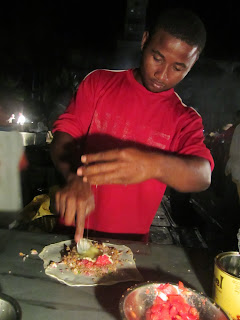
Next to him is more deliciousness. A man has a wok of a frying pan over a charcoal fire, tiny tablespoon sized dough balls under a towel, a can of ghee, a dozen eggs and a few bowls of chopped goodness. These are the ingredients for Zanzibari pizza. Spanish omelet meets Italian pizza with samosa spirit and Zanzibar spice. He prepares them one at a time. Each takes no longer than five minutes. Dough pressed out by hand, covered in vegetable mixture and beef, an egg cracked on top and mixed in with a spoon. The edges folded up and onto the hot ghee-filled cooking surface. Cook for a while. Then flip. Somehow it never falls apart. When done it is chopped horizontally and vertically to make a dozen bite-sized pieces adorned with salad and chili sauce. This is 2,000 tsh, about $1.33. We sit and eat it off a droopy paper plate on a bench overlooking the ocean.

Every so often we hear a splash and a scream followed by applause. That is when the waves crash against the wall and splash up on the people. The ocean makes better entertainment than any Moroccan monkey man or snake charmer I have ever seen.

Then there is the main event. The mishikaki. Every fourth stall has a royal spread, forty kebabs across. It starts with fish kebabs of all sorts – kingfish, shark, tuna, and countless others I don't know. Then chicken kebabs. And beef. Then mussels, lobster, crab, octopus, squid, prawns. Occasional kebabs are decorated with the bright red of the annatto tandoori spice mix. Behind the kebab infantry are the big guns. Four flat breads, some with garlic, some with sesame seeds. Whole squid. Squid in two parts – bodies and tentacles. The same with the octopus. Huge crab claws, disconnected from bodies. Huge red crab bodies, disconnected from their front claws. Then warm-water claw-less lobsters that only make the crabs look bigger. Half golden brown chickens that look deliciously seasoned and slow roasted. Then there is the starch section. Cassava, breadfruit, potatoes three ways. All available fried or heated on the grill. It yields to what is advertised as the vegetarian section. Samosas (vegetable or beef), huge bready felafel balls of two types. And bright red tomatoes, cucumbers and chopped red onion for garnish. Chili sauce and ketchup for additional spice and moisture. It is all welcomingly overwhelming. I start with a fish mishikaki and make a few passes before deciding what's next. I sleep on it and come back the next day for beef and octopus.

The colors, the spices, the tastes and smells are accompanied by the call to prayer five times a day. And vistas of turquoise water and white sand seem to await around every corner. Not every corner, just the ones that I swear are in the direction that is not facing the sea. And on the turquoise water sails a wooden dhow, surely much the same as a thousand years ago. Its white sail poses like a huge dorsal fin in the sun. You can't out-souk the souks, but this is the magic I was looking for in Morocco, with a slower pace and less hassle.

The view near Mustapha's Place

Stone Town waterfront mishikaki stand

Zanzibari pizza in progress

Jack fruit

Annatto

Jack fruit insides

A view from the water

Sugar cane juicer at work

Sunday, January 1, 2012

Mara and Mustapha's Place

Mara arrived on time. I bumped my head seven times on the dalla dalla ride to the airport. The world is not built for those who are over five foot ten. We walked across the street from the airport and drank cold Kilimanjaros before catching a taxi back to the YMCA hostel and the Holiday Inn rooftop bar across the street for a few more.
We left Mara on the rooftop while Annette and I spent a longer hour than expected on the phone to Vegas with Jennifer Henderson, getting excited about strengthening the non-profit sector in New Orleans when we get home.
We woke Wednesday morning early. Enough time to visit the fish market before our ferry to Zanzibar. At 7 a.m., the Dar Es Salaam fish market is a hive of commercial activity. People gather around vendors as the spread piles of small fish. They call in response, bills and five gallon buckets in their hands. We keep walking.
A man leads us around as we marvel at fish the length of our legs. Tuna fish. Red Snapper. Parrot fish. Octopus. Squid. Prawns of all sizes. King fish. Grouper. The man poses each fish for our camera. He asks us if we want to buy some. We explain we have nowhere to cook it. He motions at some stands across the street and says they will cook it. So, we walk across the street to find woks four feet across cooking huge vats of fish over charcoal fires. One is red, a pile of red octopus, slightly larger than my fist steam on the table next to it. We discuss what the red liquid is in the pot and why it is red. Is it red oil? Is it a dye the octopus releases? Is it seasoning? Crawfish, crabs, lobster and shrimp all change color when they cook. But mostly they don't change the color of the water. Mara is intrigued by the octopus but opts out of octopus for breakfast. Perhaps another day.
So, we walk on. Past stacks of fruit. Tomatoes. Curries and spices. Red peppers being crushed. Jars of pepper sauce. Huge breadfruit that look like the offspring of a watermelon and a porcupine. Finally, we approach some women who are cooking. They direct us to a seat. We order fish soup with chapati. It is brothy but delicious. We scoop small pieces of fish onto torn pieces of chapati bread. The chapati brings out the flavor of the fish.
By 9 a.m., we are at the Kilimanjaro booking office buying tickets on the noon slow ferry to Zanzibar. Here in Tanzania, everything is named Kilimanjaro. The mountain. The water. The beer. The ferry. The tickets say VIP on them, which turns out to be a semi air-conditioned upstairs lounge on the ferry. It has comfy chairs and not enough air conditioning. In eight months of traveling, I have learned that most of the time windows that open are better than air conditioning. But we are happy to be on the ferry to Zanzibar. Just the name elicits images of Arabic castles, exotic spices and a distant tropical paradise. Any name that starts with a z has a head start when it comes to piquing my imagination. Zebras. Zimbabwe. Zygotes. Xylophones. Ok, maybe that one is cheating. But X has a similar allure. But X isn't as smooth as Z. And most of the places that start with x are in China, which we won't be visiting on this trip.
Zanzibar slowly approaches on our port side. The sands are white. The water torquoise. Stone Town looks colonial and old, filled with mystery. And there is a big tree on the shore. It is marked in the Lonely Planet map as “big tree” with a small dot, but I don't notice this until we have already walked by it going the wrong direction. The guidebook tells us to expect chaos from touts when the ferry lands. But it is far less than the bus station in Essaouira, or anywhere in Morocco for that matter. So, we present yellow cards to customs, get a stamp on our passport, and motor through the touts offering us accommodation and taxi rides. Unfortunately, in most of Africa, they all try to become our friends first. So, the conversation goes through “What is your name, where are you from, how long have you been here, and where are you staying,” before he gets around to what he is offering. It is tiring and repetitive. A good newspaper story can capture all these basics in the first paragraph. It takes these guys a page to get there. But, as the Lion King made famous, “hakuna matata... no worries.”
We find a street vendor with mishikaka (beef kabobs) that are miniscule, fries, plantains, samosa and chicken. We eat various combinations of these for a few bucks before wandering through the transport stand in search of a 324 bus that will take us to the Rasta backpackers resort called Mustapha's Place. When I sent Mara to the website, she was sold on the subject of the first sentence, which starts, “Mustapha and his friend Culture.” No predicate necessary.
The dalla dalla cost more than it should and took a ridiculously long time, but fortunately less time than expected. But it dropped us off at the wrong place. As we pulled our packs from the back, next to a huge fishtail sticking out of a cardboard box, the dalla dalla money taker insisted this driveway leads to Mustapha's. We walked it to find the Blue Lagoon. Absolutely beautiful clear water lapping at white sands. But not our place. A taxi tried to get us for $20 to drive us five kilometers so we walked back to the road to hitch.
Sure enough the red dalla dalla drives by in a matter of seconds. It stops. The three of us yell at him about dropping us off at the wrong place. He flashes a smile and a bit more laughter than seems appropriate. But he helps us put our bags in the back and tells us to get in. We have one passenger try to call the place, but the number doesn't work. After some discussion by nearly all of the passengers in Swahili, it is decided that he now knows where to drop us. Five kilometers up, we stop. He says this is the place. We should walk down that road there. He asks a man to escort us. I see the red shipping container-turned-corner store behind a thatched porch that was described to me in the directions. So, we let the dalla dalla go and follow the young man as he leads us briskly to Mustapha's.

Sunrise at Mustapha's