Showing posts with label Hamilton. Show all posts

Wednesday, January 18, 2012

I don't know, India

I don't know what to write about. Nine months ago, I wondered what I would write about when I get home, if the daily grind of everyday life was enough to inspire regular writing. I figured as long as I was traveling, the day's new experiences would inspire prose. But now that we are the final continent of our trip, this trip at least, I can't sort it out anymore. Perhaps I forgot what is interesting when I am in an office with my daily routine. Although, back then I remember what an interruption a traveler's blogging meanderings about life and wonderment were to my routine when they showed up in my Inbox. Mostly, I didn't have time for it. Now, it all seems interesting. And, even the magic of India, feels humdrum at times.

Maybe it started in South Africa, where our travels stalled in the security of Johannesburg. Malawi was a welcome back to the road. Then Mara arrived. And we stayed in Zanzibar for more than two weeks. It was in the style of childhood family vacations in Cape Cod. We spent most of the day at the beach. We took long walks. We collected shells. Played cards. Talked about food. Found a few favorite restaurants and stuck with them. We ate omelettes and chapati every morning, with fresh fruit juice and fresh fruit. Instead of Truro, it was Bwejuu. Instead of the Yum Yum tree, it was Pakacha. Instead of lobster, it was octopus and crab. Instead of the Dolphin Fleet whale watch with its toasted buttery hot dog buns, it was the Nungwi and swimming with dolphins, followed by fried fish. As this journey has felt at various points, it felt like a fitting tribute to my mom. And my sister looked and acted as much like her as anybody ever has. More than just a tribute to my mom, it was a reminder. I will probably never go to the beach again in my life without thinking about her, feeling her spirit.

So, here we are. Day three in Mumbai. Back to walking as a city unfolds its mysteries underneath our feet. There are lots of things I could write about. Our bags' vacation from us in Oman. They got off the plane when we didn't and stayed an extra two days in the Middle East. They left us in the same clothes sharing a toothbrush for three days in Mumbai. We learned to play the game, “When I get my bag, I will...” It quickly became, “If I don't get my bag, I will...” as we resolved that there could be worse places to replace a wardrobe and our travelers' belongings than India. Then it became, “When will our bags arrive?” But, when we came back tonight to the granite and marble clad lobby of the Welcome Hotel, we found two plastic wrapped bags and denied they were our's. Then the guy behind the desk turned on the lights and I recognized the light blue of Annette's backpack.

I could write about the May Rose Bar and Restaurant that seems to be more and less than any and all of the words in its title. We stumbled into it after a romantic evening walking the promenade to Chowpatty Beach. There we sat on a mat and ate plates of sev puri, stopped for a beer, presumed to see the Queen's Necklace (which as far as I can guess, is the row of lights nearly encircling the bay in Central Mumbai). We needed a bathroom and decided we would stop for another beer in exchange. With some hesitation, the doorman at the May Rose lets us in. We find a semi-live performance inside that was inaudible outside. Four beautiful saree-clad women sit on a couch. Three men sit behind them against the wall. Each has an instrument – a keyboard, a drum, an electric drum pad. Two men stand at the front, sharing a music stand with two microphones resting on top and a half-zipped bag draped from it. They perform before a row of couches populated by a handful of men.

I take off my tattered “I love my life” visor when I enter, as if that is what makes our presence awkward. We order two beers and Annette goes to find the bathroom. Meanwhile I discover this is not a normal bar. And if by chance it is, it is not a normal night at the bar. I watch an old man call forward the woman in the red saree to pick crisp twenty rupee notes out of his hand. He waits until she sits down to present another. She doesn't smile. She seems more annoyed than anything, but each time, she goes and collects the money. She keeps in it in her right hand when she sits down. Then she texts on her phone, maintaining a look of total disinterest bordering on disgust. The two woman next to her don't get up. But their body language is similar. Arms folded. Sometimes texting on phones. Whispering expressionlessly to each other occasionally. One woman sings every fifth song before disappearing into the kitchen. The two men sing more frequently over a recording. A few notes on the drum or keyboard occasionally interrupt the recording. Perhaps they were meant to enhance it.

When Annette returns from the bathroom, I point out the oddity of the scene. So we play a new game, named, “Where are we?” My first guess is a super conservative Indian strip club in which the woman don't strip. Annette guesses “karaoke bar,” but I dismiss it, pointing to two signs that read, “Guests Not Allowed To Sing.” “Some sort of super boring bachelorette party,” I guess. The game goes on as we observe more. Then I excuse myself to use the bathroom.

The bathroom has a door that opens to a sink with a toilet room on either side of it. I find the men's room to be an all black western toilet and sink. There is no toilet paper. I pee and flush. I walk out to wash my hands to find two young men in uniforms looking at me strangely. They say something I don't understand. I am not sure if it is a proposition, a request for money, or just the usual over-staffed smothering Indian service (after Africa, at least). I return to the table to propose that it is an undercover gay bar. “There is no sex in the champagne room,” Annette responds. We laugh and eat the carrots and cucumbers that are provided, until Annette gets a perfumed and powdery bite. She informs me there is washing powder on the carrot and asks me to take a bite. I refuse multiple times until she finally lets up. We agree that we should hurry up and finish our beers, which we do. We exit.

Annette asks the doorman, “Do you speak English? What is this place?” He nods to the first question but then mutters, “no English.” Annette asks again, but again we get, “No English.” So, we walk home.

I could write about the misspellings and the signs. It makes Czech beer stains” (a.k.a steins) seem tame. “Do not pass urine here,” outside the wall of the police station merits comment. In West Africa, it just said, “Do not urinate here.” Perhaps the verb, urinate, didn't make it across the Arabian Sea. A few favorites are outside churches: “Life was simpler when Apples and Blackberries were fruit.” “We live in a rainbow of chaos.”

Then there is the strange order and modernity of Mumbai. The city I expected to be chaos, but feels far more normal than most West African cities. Yet, I am sure more people sleep on its sidewalks any given night than live in Accra. And the modern glass buildings give way to the sensory and chaotic markets that Moroccan souks aspire to be. We stop at a spice counter where 59 masalas are laid out in Indian metal dishes for our noses. We don't buy anything. I am reminded of the institutional feel of India. Bathrooms of black and gray stone. Cups and dishes of shiny tin.

And then there are the odors. A short walk reveals urine, incense, curry, shit, ox, citrus, cinnamon. And that is the first five steps.

I could always write about the food. That is a favorite subject, and as good here as anywhere. We haven't eaten meat in two days and barely noticed. We discovered vada pava – a fried lentil and potato ball served on a small white bun like a vegetarian White Castle burger. And Annette has fallen in love with sev puri, which, as far as I can tell, are the nachos of the Indian puffed rice family. Mostly I can't write about the food because I don't know the names of things and am at a loss to name the ingredients. Coriander is my favorite. It clicked for me before we left Tanzania that coriander is cilantro back home. Surely my foodie sisters would call me slow. But I eat fast.

I will let you know when I find something to write about...

Mumbai!

Sleep mixes with excitement like the sun rising amidst the haze of Mumbai. It all feels other-worldly. Despite the big orange globe on our left, it still seems barely to be dawn here. Neither of us slept much on the flight between the crying babies and the bright lights. We are without bags, thanks to Oman Airlines. But it is a fitting entry to India, a land that will always challenge our materialism.

Our taxi driver stops en route and gets us two glasses of hot chai. Welcome to India. We nap at the hotel and wake to find an India I didn't expect. I expect Mumbai to be like Old Delhi, but worst. A jumble of chaos, dirt and humanity. But it is Sunday morning. And even the huge Victoria Terminus Train Station, the largest in India, is quiet. The skyline is filled with modern looking buildings. And the streets of Fort are lined with colonial era buildings. It feels more like Barcelona or Manhattan than I expected. But, alas, India will be full of surprises.

We are both tired, but happy to be here!

The Breaking Point Trilogy

It turns out the breaking point is a trilogy. I didn't realize it at first. But then I noticed there was a distinct line of brown in front of the waves a mile off the beach in Bwejuu. I realized the difference between low tide and dead low tide. Apparently, my last effort to walk to the breaking point was at low tide. I would try again at dead low tide, as I see the silhouttes of men out there, walking on the reef, what seems to be dry land.

Annette joins me with the camera. We photo the seaweed beds. I point out crabs. With her at my side, I am bolder than usual. I touch things I normally wouldn't. Pick up huge red and orange starfish. Check to see if the various corals feel like I imagine them to. Three hours of exploring this incredible underwater world that has come to the waterline. Three hours and we reach the reef, tired and surrounded by sea urchins. I nearly drop the camera in the water on the way back. Annette drops her whole body in the water, butt on to the spines of sea urchins, but saves the camera.

Our final voyage to the breaking point is the most incredible yet.

Tuesday, January 3, 2012

Zanzibar!

Zanzibar is what I expected Morocco to be like. It is an enchanting place, ripe with the histories and mysteries of Omani sultans and Arab traders. Swahili is a beautiful language, part African, part Arabic. Stone Town's alleyways are lined with fruit vendors, small shops with woodcarvings, Masai beaded jewelry and paintings. They are car free. Just children running, occasional carts passing, bell-ringing bicyclists, meandering pedestrians, and a periodic motor bike. The streets look like you don't want to walk down them at night. But beyond each narrow passageway is a new discovery. A Hindu temple. A mosque. A school with children's voices ringing out the window. A market. Complete with fish of all shapes and sizes, fruits and vegetables of all colors – delicious avocados, tomatoes, breadfruit, jack fruit, mangoes, lychees, pineapple, apples, oranges, limes – and spices – saffron, clove, lemongrass, turmeric, bright red tandoori masala, vanilla, cinnamon ginger, curries.

When we wander out from Stone Town on a spice tour, we find all of these spices in a short walk. Each tree or bush provides something new. Huge jack fruit the size of the biggest watermelons dangle along the trunk of a towering tree. Vanilla beans still green, pollinated by hand, hang in groups. Lemon grass sprouts knee high from the ground. So does cassava, turmeric and ginger, a hint of their roots visible through the soil. Lime, mango, cocoa, breadfruit all over head. A pineapple sprouts from the center of a grassy plant, a gift presented as if for a king. A grove of cinnamon trees show, vertical stretches of bark removed to the scented delight of tourists. And clove leaves. When crushed they smell magic and deliciously familiar at the same time. And then there is the annatto, a small seed the size and color of a peach pit with fur on the outside. Inside are small red pods. When crushed, they solve a tandoori mystery. It is this bright red dye that colors the tandoori spices so brilliantly.

The smells are only matched by the colors. It is no wonder everybody here dresses in such brilliant colors. They are everywhere, in the hibiscus, the acacia, the bougainvillaea, the annatto. The same brilliance we see snorkeling along the reef the following day. I name rainbow-zebra fish, parrot fish, blue starfish, in the absence of any taxonomy. It is all far beyond anything I could imagine. The coral seems to breathe. And schools of fish mimic this coral in the currents. Huge sea anemones with the quills of a porcupine sit silently on the sea floor amidst coral that looks like mushroom caps of all varieties. Then there is the coral that looks like a huge colorful yellow brain. Gray matter just isn't imaginative enough. For every piece of coral, there seems to be an equal and opposite fish, its long mouth designed to extract food from amidst the coral. Its coloration camouflage for some unseen predator.

We each get a small pouch made from banana leaf in which to gather our spices. And we taste everything. Right on to green coconut, pineapple-tasting jack fruit, sour starfruit, turmeric root. I pick at the root for a taste. It comes off in circles like a carrot. It will take two days of ocean waves to remove the yellow from under my nails. After a smell and a taste, each goes into the banana-leaf pouch to make a pourri that we will later use in our bathroom.

Before sunset, we walk along the water. We watch a dozen teenage boys jump off the wall into the ocean. They take turns, like at a skateboard park. Each sprints twenty feet before leaping off of the stone wall in a trick while falling twenty feet into the Indian Ocean. Meanwhile the others watch. Some dive. Some spin and flip. One runs in slow motion in the air. Most land at odd angles, but seem to be unfazed by it.

Here the sun sets over the water. A bit before its departure, the promenade comes alive with street vendors. Maybe thirty in all, they are gathered in four or five squares around a fryer and barbecue. A man shoves meter sticks of sugar cane through a press for juice. Then he folds them over, sticks lime quarters and ginger chunks in the middle, and presses them again. And again until a cup of delicious lime, ginger and sugar juice comes out. Next to him, a woman has a pot of mango soup over a small grill, lumps of potato inside. It is served with small felafel balls and chopped green leafy garnish. A bowl is one thousand Tanzanian shillings, about 65 cents.

Next to her is the fruit man, a rainbow of freshly chopped pineapple, mango, papaya, avocado, watermelon and coconut on display.

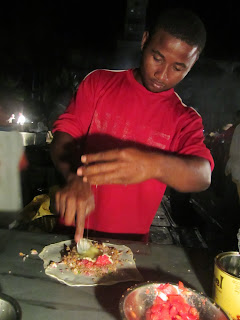
Next to him is more deliciousness. A man has a wok of a frying pan over a charcoal fire, tiny tablespoon sized dough balls under a towel, a can of ghee, a dozen eggs and a few bowls of chopped goodness. These are the ingredients for Zanzibari pizza. Spanish omelet meets Italian pizza with samosa spirit and Zanzibar spice. He prepares them one at a time. Each takes no longer than five minutes. Dough pressed out by hand, covered in vegetable mixture and beef, an egg cracked on top and mixed in with a spoon. The edges folded up and onto the hot ghee-filled cooking surface. Cook for a while. Then flip. Somehow it never falls apart. When done it is chopped horizontally and vertically to make a dozen bite-sized pieces adorned with salad and chili sauce. This is 2,000 tsh, about $1.33. We sit and eat it off a droopy paper plate on a bench overlooking the ocean.

Every so often we hear a splash and a scream followed by applause. That is when the waves crash against the wall and splash up on the people. The ocean makes better entertainment than any Moroccan monkey man or snake charmer I have ever seen.

Then there is the main event. The mishikaki. Every fourth stall has a royal spread, forty kebabs across. It starts with fish kebabs of all sorts – kingfish, shark, tuna, and countless others I don't know. Then chicken kebabs. And beef. Then mussels, lobster, crab, octopus, squid, prawns. Occasional kebabs are decorated with the bright red of the annatto tandoori spice mix. Behind the kebab infantry are the big guns. Four flat breads, some with garlic, some with sesame seeds. Whole squid. Squid in two parts – bodies and tentacles. The same with the octopus. Huge crab claws, disconnected from bodies. Huge red crab bodies, disconnected from their front claws. Then warm-water claw-less lobsters that only make the crabs look bigger. Half golden brown chickens that look deliciously seasoned and slow roasted. Then there is the starch section. Cassava, breadfruit, potatoes three ways. All available fried or heated on the grill. It yields to what is advertised as the vegetarian section. Samosas (vegetable or beef), huge bready felafel balls of two types. And bright red tomatoes, cucumbers and chopped red onion for garnish. Chili sauce and ketchup for additional spice and moisture. It is all welcomingly overwhelming. I start with a fish mishikaki and make a few passes before deciding what's next. I sleep on it and come back the next day for beef and octopus.

The colors, the spices, the tastes and smells are accompanied by the call to prayer five times a day. And vistas of turquoise water and white sand seem to await around every corner. Not every corner, just the ones that I swear are in the direction that is not facing the sea. And on the turquoise water sails a wooden dhow, surely much the same as a thousand years ago. Its white sail poses like a huge dorsal fin in the sun. You can't out-souk the souks, but this is the magic I was looking for in Morocco, with a slower pace and less hassle.

The view near Mustapha's Place

Stone Town waterfront mishikaki stand

Zanzibari pizza in progress

Jack fruit

Annatto

Jack fruit insides

A view from the water

Sugar cane juicer at work