Saturday, November 12, 2011

Itinerary for the next few weeks and months

So, after much back and forth, we finally completed booking a ticket today with Ethiopian Airlines.

We will spend the next week in the Volta Region of Ghana.

Then back to Accra Friday night to fly out Saturday. We fly via Addis Ababa, Ethiopia, where we will spend Saturday night. Then on to Johannesburg.

We will be in South Africa for about three weeks. We will start with laundry and other luxuries in Joburg. We will spend a week or so in Cape Town and perhaps explore some of the West Coast and the East Coast.

Around December 10th, we will begin heading north overland through Mulawi and perhaps Zambia. We plan to travel over land in order to meet Mara, my sister, in Dar Es Salaam, Tanzania on December 27th. She will be with us until January 14th while we explore Tanzania and perhaps Southern Kenya.

Then we hope to go north overland and fly Addis Ababa to Mumbai by early to mid-February.

Mole National Park

In the footsteps of elephants.
Bok with leafy-eared baby.
Bok.
Monkey in the road.
We watched the burning ball retire for the evening from the orange Metro Mass Transit bus from Tamale to Mole National Park. What was three seats across yesterday is now five. And people stand in the aisle. But the sun's departure and the approach to Mole bring a welcome coolness. And a brilliant full moon rises, a star, presumably Venus, standing guard directly to her right. The ride has been bumpy and filled with red dust for hours. Now, the bus brakes not for poor road conditions, but antelope in the road. We are getting close to our destination.

We are welcomed by warthogs, millipedes and bok (antelope that look like white-tailed deer) outside our door at Mole. We sleep off a hard afternoon's travel after a beer and some chicken and rice. We wake early for our 7 a.m. walking safari through Mole. I step outside to find two warthogs crouched on bended front knees to allow their massive heads to get closer to the grass for grazing. They are ugly. An inconsistent tuft of hair lines their spines. Warts dot their face. Curly horns poke through like zits and the few awkward first facial hairs of a teenager. They snort a bit, but are mostly undisturbed by us human-folk.

We meet around some benches under a tree. There are two groups of seven. Our guide, Isa, carries a shotgun over his shoulder. He has been working in Mole since 1973. He is a man of few words. He leads us past warthogs and monkeys and into the bush. We swat bugs away as we gather mud and dew on our boots. Occasionally, Isa stops to point out the hole of an aardvark, the tracks of a nocturnal hyena, an antelope ahead. Mostly he points with his walking stick in silence when there is something to see, so as not to scare the animals away. He shows us traces of elephant. Jurassic Park sized footprints. Trees torn down. Roots dug up. Bark worn off. The noisy Germans in our group eventually quiet down as we walk through high grasses, thin woods, along and across a muddy stream. We see monkeys, warthogs, antelope (bok), birds. The call of the plantain eater seems to follow us. We search for elephant, but only find more warthogs.

After nearly two hours we emerge at a pond below our accommodation. There Annette spots an elephant. It is bathing. It's ears are half submerged. One can get no sense of its size. In three minute intervals, it blows water on its back with its trunk. Birds circle. It reminds me of a whale watch. The highlight being its breach, in this case when it lifts its trunk from the water, flaps its ears, and sprays water on its back. We watch it for several minutes before the guide reveals our time is up. He must lead us back to our hotel. We spot a large crocodile before crossing a small stream and scampering a kilometer or so up a hill to the escarpment that is home to the Mole Motel.

We eat breakfast, shower, put on bathing suits and soak in the pool. A baboon with baby on its back struts by. Annette calls me out of Invisible Man (the book I am now reading, thanks to the good folks in Mankessim) having spotted more elephants. An observation deck near the pool looks over an impressive uninterrupted landscape of trees. Immediately below us are a series of watering holes an open grassland speckled with small woody areas. There is a huge elephant with two tusks walking from the pool. In the pool behind it are an additional two. We pull up chairs and proceed to watch two elephants charge each other and lock trunks. One walks forward, the other back. There must be thousands of pounds of force between them. But it all looks entertainingly innocent from here. The antelope run away from the action. A safari driver tells us that male elephants usually fight over food, not females. This fight has a clear winner. The loser retreats to another tree to munch.

We alternate watching elephants soak in the watering hole and soaking ourselves in the pool. The heat seems oppressive. When not submerged, we cling to the shade underneath an umbrella and read. Even in the heat, the air is fresh. The horizons are far enough away to provide the peace of mind that only comes with a lot of space and nature.

I opt to go on the afternoon walking safari, despite the 3:30 p.m. heat. Once again, Isa is our guide. This time, I stay on his left shoulder, just behind his Department of Forestry Wildlife Division patch and his shotgun. Six elephants walk within twenty feet of us. They are massive. They crash through the trees with an amazing grace, especially considering the destruction they wreak. They are on the move, hardly stopping to eat. We follow them for a while, before parting ways. We literally walk in their colossal muddy footsteps for the rest of the afternoon. We follow a family of water bok. They look like big red elk. The males have two curved horns that impersonate the shape of their head. They act like deer, sprinting away from us, turning to see what's happening, ears perked. Their tails wave incessantly, almost as persistent as the flies.

The plantain eaters seem to laugh in the distance. They sound like children playing in a nearby village. They look like plantain eaters. Birds with curved beaks, like the stem of a plantain. They have long tails and fly in fluttery bursts like a magpie or a cedar waxwing. We see heron, ibis, guinea fowl and those small white storks that follow the elephants. They remind me of the birds you look for on a whale watch, tell tale signs that huge mammals are nearby. They exist in a similarly symbiotic relationship, picking ticks and dead skin off the elephants' backs. 

We see more warthogs. And monkeys who seem to pose for the camera this time rather than run away from it as they did this morning. We approach the morning's watering hole from the other side this time. A crocodile scampers out from its muddy camouflage feet from our feet to our surprise. It belly flops into the water with grace I could never seem to muster in a belly flop, a cannonball or a dive. Two more follow. One is noticeably smaller. The whole group takes photos and moves closer to the safety of the shotgun on Isa's shoulder.

We hike back to the hotel as the sun burns a huge patch of clouds brilliant red and orange. Tonight we catch the only bus out of here, at 4 a.m., back to Tamale and then onto Accra, where we may have to fight Ethiopia Airlines to get a decently-priced ticket to Johannesburg. Then onto Botanical Gardens, hills and waterfalls in the Volta region before we leave Ghana.
A warthog munches on bended knee outside our Mole Hotel.
Elephant in the forest.
Isa and the water buck.
Elephant bathing.
Isa shows us elephant-damage on a tree.
Sunset over Mole.

Tamale

We pulled into Tamale about 1 p.m. Six hours on an air conditioned bus, only three seats across that look like they were pulled from a 1985 first class section of a Boeing plane. (A lot of the decor in West Africa looks like it came directly from 1985). The bus' comfort is almost enough to isolate us from the long stretches of bumpy roads below. Bad Nigerian movies play throughout the ride. Sound levels fluctuate throughout the movie as if it was all recorded with only the microphone built into the camera. That means when people are further away, it is quieter. And when one woman in the movie washes dishes, the clanging makes the dialogue inaudible.

Tamale is a simple city, the fourth largest in Ghana. Its streets are almost grid-like, each lined with the colossal street lights of a European highway interchange. Most of the street side gutters are covered. And there are bike lanes, well-used by pedestrians, motorcycles and a healthy portion of good old-fashioned pedal bicycles.

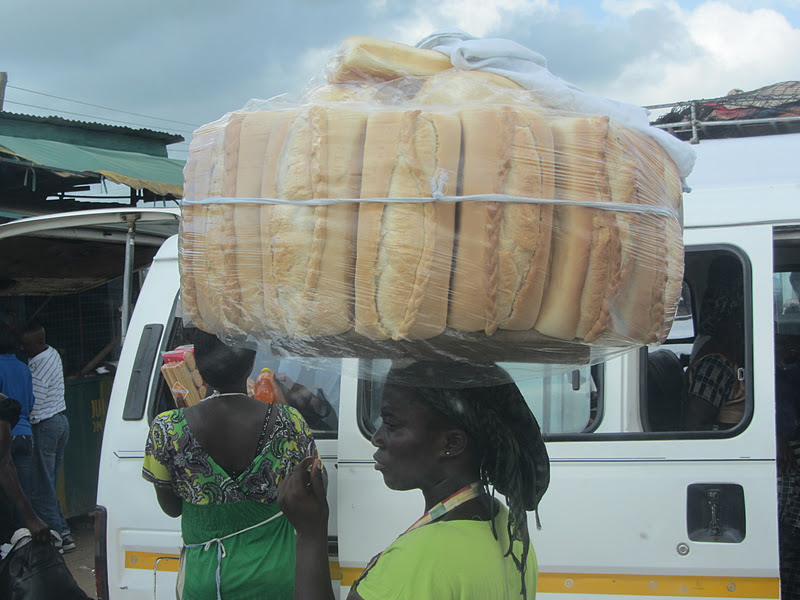
The neatness of the streets yields to the usual chaos of a West African market. The usual loaves of white bread are supplemented by loaves that have the look of a baguette and the texture of Wonder bread. We watch fufu being pounded while we wait for our plantains to fry. Richard Simmons should have made a workout video out of this. It looks about like splitting wood, except, in this case, with a partner to place each log.

The usual huge metal bowls of black-eyed peas, corn, seeds, beans and rice adorn the market alongside tomatoes, onion, yams, okra, garden egg, peppers, plantain, orange and smoked/dried fish of all sizes. And then there's yesterday's “sabo nama,” Twi for “new meat.” Cow heads, legs, ribs, rumps and sides dot the market. Now they are a few days old Meat is carried on heads and tied to the backs of bicycles. Eid's bounty is now attracting flies and making Annette swear off meat. Fortunately, the scents of spices stacked in bowls that rival Morocco provide welcome olfactory relief.

Tamale's market is nowhere near the size of the Kejetie Market in Kumasi. But this market has items of ritual and magic. Raven's beaks. Monkey skulls. Tortoise shells. Horses' tails. Chicken feet. Curled, dried lizards. Skins of snake and crocodile. Undoubtedly, each item has a particular purpose. But it is unknown to me. There are no labels on the backs. So, I don't know which cures headaches and which handles diarrhea. So, we take a picture with permission and walk on.

Sometimes I think the market place is a metaphor for life. Or, at least, a mirror. It's chaotic. Filled with buying and selling, hustling, great deals alongside ripoffs. Its exhilarating and exhausting. Sometimes a place of absolute wonderment, capturing our wildest imagination. Sometimes a maze, hot, stinky, almost sickening. I love it and I hate it Mostly, I love it a lot more than I hate it. And when I hate it, a bit of rest usually restores the love. And that about sums up my experience in Africa thus far.

We stay with our newest couchsurfing host in Tamale, Abdul Rafik. He is 26. Has a two year degree in computer science and can't find work. Like many of the young people we've met in Ghana. He and his roommate live in one room that's about 12 feet by 12 feet. It has a TV, computer, mattress on the floor and wooden closet. They have a shoe rack by the door well-supplied with men's shoes. Presumably, these are Philip's, Rafik's roommate's. Presumably he wears them at the hotel where he works nights. His working nights helps leave enough floor space for our sleeping mats and mosquito net.

The bathroom is shared. It consists of four concrete rooms. Two only have drains in the corner, for bucket showers. Two have a bench with a hole in it. Under the hole is a bucket filled with shit and maggots and a few strands of toilet paper. I squat over the hole to shit and hope maggots don't fly in my butt. Annette holds it and constipates herself. Easy enough for one night.

We sweat in our sleep. My sweatshirt I use as a pillow is drenched in sweat by midnight. But, as usual, I wake up a coolness that stagnantly sits somewhere between tolerable and comfortable. Morning is always the best like this. But with light now shining in the door, I opt for a cold bucket shower over more sleep.

This is followed by a walk around the neighborhood. Everywhere, children are headed to school, on foot, on bike, on moped, in the bed of a pickup truck. Accompanied by siblings, classmates, parents. It is a relatively cool morning (as determined by the fact that it is 7 a.m., I have been walking for ten minutes and I am not yet drenched in sweat). Early mornings like this are precious and beautiful. This time tomorrow, we will be hiking alongside elephants in Mole National Park.
 
Assorted items of ritual and magic.
 

Tuesday, November 8, 2011

Eid


A cow's blood is drained to the ground.

And washed.

I join in for a bit on the skinning of a cow.

The cow's head and legs rest to the side while the rest is butchered.

Kids play on a dead cow beyond a pool of blood in the street.
There's blood on the streets of Kumasi. There is blood on the streets all over the Muslim world today. Eid Al Adha commemorates Abraham's willingness to sacrifice his son at Allah's request. At the last minute, Allah substituted a ram. So, now many sheep die each year. Cows, however, are the more popular choice of sacrifice among Muslims here in Kumasi. Samad, our couchsurfing host, estimates there are three thousand cows killed today in Kumasi. We have seen cows and sheep being gathered over the last week. Pick up trucks with cows in the back have been moving around the city. Herds have been in the streets. All moving to slaughter.

In a land where we think meat comes in supermarket packaging, it is refreshing to see a cow alive and then eat part of it in the same day. It is certainly more humane than any factory farm or slaughterhouse. But it still seems rough.

Annette and I are spending the holiday with Samad's family around the Kumasi Central Mosque. It is much like any other holiday in many ways. We start early in our best clothes (Annette's purple and pink Moroccan jalaba and my white collared shirt and gray slacks). We visit and meet many family members across multiple households.

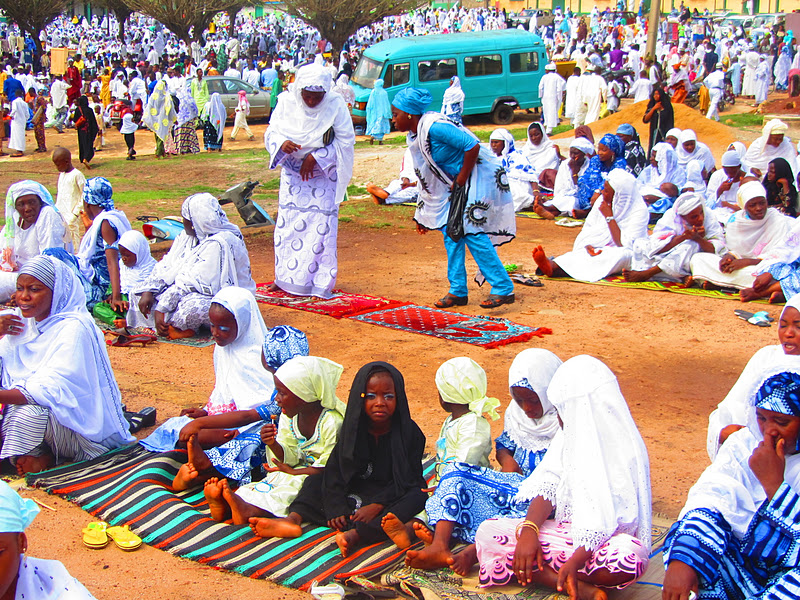
We go to prayer at the Central Mosque, which is in the backyard. There are easily three thousand people there gathered in prayer, led by the Imam. Chiefs from the various surrounding villages arrive in procession, under umbrellas, accompanied by entourages. People gather with their families, organize themselves neatly in rows, lay out prayer rugs and wait. The prayer itself is no more than twenty minutes. We come up with red dirt on our foreheads. Then the prayer rugs are rolled up, greetings exchanged just like after church. Slowly people make their way back to the vicinity of their houses.

The streets are busy and festive. People greet and gather, clustering to the shade, sitting on wooden benches around the streets. Under a tree at the intersection behind the mosque, cows are gathered and tied individually. One beige brahma bull with six feet of horns is tied to a tree branch. Another is tied to a car axle inserted perpendicular into the ground. Still others are tied to other parts of cars made into hitching posts in the ground. The leashes are short, usually around the horns and then two feet or so to the car axle or tree. Not enough leash for one injured cow to lie down and take the weight off of its bad leg. Another has its rope caught in another bull's horns. For hours, it seems, we sit and watch the cows in their discomfort.

Then, throughout town, holes are dug. Or perhaps they were dug yesterday. But they are there. Two feet deep, two feet across. Cows are marched from the tree. One man in front holding the leash that leads around their horn or neck. Another with a rope around it's back foot. They slap, yell and whip to get the cow to move. Sometimes it charges. Sometimes it resists stubbornly. Children gather around and then run all directions when it starts to fight. Occasionally a cow gets loose and a parade of children and young men race the streets after it. But it has no place to go. So, five minutes later it is marched back down the road, its spirit slightly more broken than before.

When the cow reaches its destination, the men wrestle it to the ground and wrap its legs in rope. Some cows put up a fight which makes things interesting. Others go down easily, seemingly accepting their fate. With all four legs tied tight, the cow is pushed and dragged by its horns, tail and any other part a person could grab until its neck is over the ditch. Then its head is twisted by the horns to nearly 180 degrees. Its eyes roll back in its head slightly. Then a curved seven-inch knife that looks like a scimitar across its neck. Blood pours into the hole. It squirts with a hiss toward the children gathered. They scream and laugh and run back. With every last beat of the cow's heart, more blood pours out. A few final kicks. A moan. Some twitches. The blood continues to drain out.

After twenty minutes or so, the cow is then dragged to the center of the family compound. The head is chopped off and put aside. Then its elbows and knees cut, cracked back, and removed. Its skin is removed with a knife, some cutting and pulling. I take part in this. It comes off easily, like peeling back the skin of a turkey to insert garlic and seasoning. But, with a bit more elbow grease. The skin then becomes the plate on which the butchering takes place.

The two male butchers are systematic. They will do three cows before the day is over. The method is the same. The cow is bound, neck over the pit. Throat slit. Blood drains. Cow dragged to compound. Head and forelegs removed. Skinned. The last piece of skin to come off is always the tail. Cut open down the stomach, between the balls. Penis, testicles, liver, stomachs, intestines removed. At this point, I already start to smell meat cooking. Then a few swings of the machete to hack through the ribs. Slowly, it becomes several huge metal bowls full of meat. These are carried away to kitchens. One third is supposed to be given to the poor. The liver is always cooked first. By 4 p.m., it is ready. Grilled, well-peppered, served with onions, tomato, cucumber. It is the best liver I have ever had. I don't like liver, but it is delicious. Surely hunger helps. And not having eaten more than a bowl of spaghetti all day, I am famished.

It seems as soon as a cow is marched off for slaughter, a truck or minivan appears with a cow or two bound in the back. The cow is rolled off and out of the bed, crashing to the ground in a cloud of dust. Carefully and not precisely, it is unbound and tied to one of the car axles mounted vertically in the ground. Then, it too, is walked off to slaughter, one boy leading it by the horns, another with a rope around its hind leg.

Cows are brought in by trucks through Kumasi.

And unloaded by men.

Prayer at the Central Mosque

The Central mosque on Eid.

Saturday, November 5, 2011

Chants, Prayers and Slogans

We planned to leave Mankessim on Tuesday, but our clothes on the line were still wet and we heard too many speeches. We went to the grand opening of a school outside Cape Coast. It was funded by a British oil company and build by a British NGO (Sabre Trust). It is beautiful. Mostly bamboo. Excellent natural ventilation through a series of accordion shutters that run the length of the classroom on one side as doors, the other as windows above shelves filled with schoolbooks. It is a kindergarten, a small one at that. Three classrooms. But it is part of Ghana's efforts to make good on universal kindergarten education. It is law but there are no facilities. Something like 11% of Ghanaians currently attend kindergarten.

That is what I learned sitting through two hours of speech making before the ribbon cutting, honorary youth soccer game, and drumming and dancing that marked the dedication of the school. And I learned that they like speech-making. There were speeches from at least 80% of the white people in attendance. And representatives read papers with speeches with staples in them in monotone English on behalf of absent politicians representing the Central Region, the Ministry of Education, and countless others. The oil company guy got lots of time on the microphone. God, the chiefs and elders, the oil company, and Sabre Trust got more shout outs than there will be children in this school. By the time it was over, our 10 a.m. departure would be lucky to be 5 p.m. So we decided to chalk it  up as another great day in Ghana and try again tomorrow.

A girl holds scissors for the ribbon cutting.

Dancers.

The new school.

 
We made it out of the house by 8:45 a.m., bags in the bed of the Toyota Hilux. Late enough to make Allen late for his 9 a.m. Global Brigades staff meeting at the house we were departing. Early enough to make it to Kumasi and on to Agogo via tro tro, provided all goes well. We arrived to the tro tro station in Mankessim to find a tro tro with one seat and no room for our bags. So, we walked across the lot to an empty tro tro and decided to be first in. We slid one bag in underneath the seat and clipped Annette's backpack behind the front seat and waited. Tro tros leave when they are full. Our's would take about 35 minutes to fit 15 people into a space that can't be designed for more than 10.

While we wait, we watch. A boy sells some sort of packaged chips out of a wooden blue box on his head. White words scribbled in the print of a 12-year-old on the back of the box say, “I love my life.” Same as my faded, sweaty visor. Another woman walks by with a box on her side. It has four glass sides and a shelf inside. It's octopus. A young girl explains this to me and asks me if I want some. I decline multiple times. Finally another guy gets some and hops in the back of the tro tro. The parade of items carried on heads continues.

“Pineapple, waaaaaan seedee.”
“Plantains. Waaan seedee.”
“Fried rice, waaaaan seedee.”
“Bread, waaaan seeedeee.”
500 ml bag of water, 5 pesewas.

The parade continues. Boiled eggs. Live chickens. Posters and DVDs with graphic images of Qaddafi's lifeless body. Talcum powder. A counting chart with the numbers 1 to 100, an English word below each number. Sleeve-like bags with three apples stacked in them. Also one sidi. Rolls of toilet paper. Often little feet stick out from the backs of the women. Babies ride momma’s back, usually asleep while momma hollers, “waaaaan seedee.” We see the individual toothbrush Annette has been looking for and buy it for a grand total of, you guessed it, one cedi.

I love my life.

Bread for sale.

 
When the driver is done shouting “Kumasi,” we are full. He brilliantly maneuvers us out of the parking lot crowded with chickens, goats, taxis, unidentified bundles and sacks, trucks, small children, wooden shacks, and an occasional lizard in addition to people selling things from their heads. We are on our way to Kumasi, a ride promised to be three to four hours that turns out to be five without stops.

Annette and I sit in the front of the tro tro, prime seats for watching the action outside unfold. My arm slowly burns as it hangs out the window. My feet and even my head fall asleep at various points. The driver dodges potholes, manholes and sinkholes. “Poor road conditions are a good speed deterrent,” I think to myself. Instead of driving 120 km per hour, we drive slower and into oncoming traffic to avoid huge holes in the road. That's gotta be safer. We pass through a landscape of bamboo, palm and thick undergrowth. Occasional sentinel trees pierce the horizon alone. They are easily 100 feet tall. Roadside stands display pineapple, plantain, tomato.

The goods carried on people's heads get more impressive the further out we get. Huge bamboo logs, sacks of firewood, bags of rice, huge metal bowls filled with bags of water. Strong necks. I think to myself that I would probably sell toilet paper off of the top of my head. It doesn't get much lighter than that.

And the t-shirts people wear say all kinds of things. It seems like most folks are completely unaware of what is on their t-shirt. This is odd considering how long the looks are at my Dr. King Day of Service 2008 t-shirt. But maybe that is because it has a picture on it. So small children with t-shirts about sex and drugs is ordinary. A schoolgirl walks past our tro tro with a cannabis t-shirt. A strapping young man digging a drainage ditch at a school wears a bright red shirt. It reads, “NUTS ABOUT FRUITCAKE” in big letters. Another wears, “Wisconsin: The Badger State.”

But the t-shirts don't hold a candle to the car mantras and storefront slogans. I love a slogan as much as the next guy, so how can I not want to buy something at “No Weapons Cosmetics,” or “Lion of Judah Food Store?”

We see tro tros and taxis invoking the names of Jesus, God, Jah, Allah and Yahweh, usually with a blessing or a grace.

And there are ample driving contradictions. Like the taxi that tears through town at 120 with the “On God's Time” written across its rear window. It's true. Driving like that means you are on God's time cause you won't live long on man's time that way. If it wasn't for the thick black smoke coming out of the speeding tro tro with the slogan “Don't hurry,” I would let out an open-mouthed laugh. The car with the “Be Careful” on the back window merits the same response. And “no weapons” on a tiny taxi packed with people and plantains hanging out the back under a trunk tied with twine can only mean, “my car is not intentionally a weapon, despite how I am driving it.” “The Blood of Jesus,” reads one windshield. I cannot help but finish the sentence, “will be spilled alongside the blood of all of these other passengers because I drive like a crazy man.”

“GOD IS ABLE,” one tro tro proclaims. Good, because it looks like we will need him when this tro tro breaks down any minute now. Another says, “Holy Ghost Power.” Good, 'cause with these roads, horsepower ain't gonna cut it.

“Victory Ahead,” says one taxi as it's driver guns it like it is in a Formula One race.

Then there is the philosophical but obvious: “God is God.”

But they venture away from the religious, leading me to believe my next career should be in writing African proverbs. “No Food for Lazy Man,” one truck windscreen says. “Just Do It,” says a small taxi's back window. I have heard that one before somewhere. Hmm.

“Consider!” proclaims another. Consider what, I wonder?

“Life.” “Beloved.” “Good Daddy.” “Respect the Police.” “I'll Be There.” “Confidence.” They continue.

“Enemies of Progress.” This must be a statement about the other drivers on the road. “Black History.” “Sweet Mother.”

We drive through several police roadblocks, each sponsored by “Latex Foam.” They advertise their “honeymoon mattress” at each and every roadblock stretched across both lanes of traffic. And the police are known for requiring bribes. When we were with the Global Brigades folks, Orion made the mistake of giving one police officer his license. We had to pay five sidi to get it back. The tro tro drivers are smoother. They leave a two sidi bill folded inside the registration certificate. Everything miraculously checks out all right upon receipt of payment.

We eventually make it to Agogo by dusk where these two exhausted travelers are warmly welcomed by Samad, our newest couchsurfing host. He is from Kumasi, a 24-year-old accountant who works for a British timber company. He quickly introduces us to have of the people in their twenties in the hilly town of maybe ten thousand that is Agogo. I had the distinct pleasure of drinking ginger gin before 9 am with a police officer in uniform, gun on the bar. He was stumbling drunk by 10:30 a.m. Presumably he spent a few hours passed out on a Latex Foam Honeymoon Mattress at a nearby roadblock later that day. Annette and I had the distinct pleasure of sleeping on a brand new one still in the packaging our first and only night in Agogo, presumably paid for by the British timber company. It was heavenly. But I wonder, if it is a honeymoon mattress, does that mean the magic of it disappears after you've had it for a while?

Samad connects us with his cousin Alhassan, an accounting student from Ivory Coast, who lives in Kumasi. We stay with his aunt, Mama Dora, who cooks delicious Ghanaian food – jollof rice, plantains, yams, red sauce, fried fish. He plays tour guide calmly and brilliantly. People say Ghana is very religious because of its slogans. But some people who live in Ghana just say Ghanaians like to party and use slogans. I thought it was the latter until Annette and I found ourselves waiting for Alhassan to pray outside of a mosque in Kumasi during the Friday midday prayer. Black men line the street and stack the sidewalk, maybe two hundred of them, all unified in prayer. Each with a carpet laid out in front, shoes removed, hands and feet cleansed carefully from teapots of water. Very moving.

This weekend we will join Alhassan and Samad for the celebration of Ede, which we have heard about eagerly since Aquermood, Morocco. In addition to sheep, here cow's are slaughtered for the occasion. And we have seen herds of them gathering around Kumasi for the occasion. Then, we will head on to Tamale Tuesday morning and Mole National Park.

Just another Ghanaian meat shop...

Saturday, October 29, 2011

Small Comforts

When you have been traveling long enough, you start to appreciate things you barely noticed before. I was wondering when we would reach this point. Surely a good sickness increases the speed of its onset. So, here I am. Sitting in the offices, home and headquarters of Global Brigades Ghana, enjoying the simple things.

Good British cheese. So good that sharp cheddar on top of yesterday's white rice cooked in oil and garlic is downright delectable.

Good books. Scratch that. Free readable books. I have engorged myself on obscure history and hiking tales this week. The Pueblo Revolt had enough on the flap to get my attention. It is the story of the first American Revolution, the book claims. Nobody pays attention because it was the Pueblo revolting against the Spanish monarchy, not British. But, it counts, the back cover argues. And it is an interesting history of colonialism. No matter that it is another continent, another European empire, a different indigenous people. It is enough of a backdrop for my current travels. And the bookshelf at Global Brigades merits some good picking. I devoured Bill Bryson's A Walk In the Woods in less than 24 hours. He is self-effacing enough. He intersperses enough local history and environmental politics to keep an 850 mile walk in the woods interesting. His comedic comrade Katz conciliates his efforts. Perhaps Kerouac next. Or back to Steinbeck. Or Hesse, if he doesn't get too philosophical and hard to follow. (Why can't they all read like Siddhartha?) Anything that has some relevance and inspiration for this blog-writing traveler with ample time on his hands. I think often of the books I have passed in the tiny English sections of used and new bookstores along the way. Books I decided against, from a history of Basque Country to a dusty worn Nabokov to Martel's follow up to Life of Pi gleaming and crisp on the shelf. In hindsight, it seems like any of them would be a welcome gift, a downright blessing.

Americans. What can I say? I like em. They are welcome sights, accents, world views even, especially when they are interesting people doing interesting work. I supposed the traveling American is, in general, more interesting than the stationary one. At least, I think I am. More interesting than I was, that is. My concerns seem mildly more interesting. I used to worry about being on time, how much I have to do, or what's for dinner. Now I worry about getting off the roads of Ghana before dark, not getting sick, and what's for dinner. And the answer to what's for dinner always satisfies me, as long as it is something and it doesn't make me sick.

Domestic chores. When you are traveling for a year, there is nothing quite as comforting as doing laundry or cooking. I even found myself mopping a laundry room today with a smile after the washing machine had hopped across the room, divorcing itself from its drain pipe. It's a washing machine. It does laundry a million times better than I do with some washing powder, a sink and some feeble attempts at agitation. I can't even get visible dirt to disappear from my clothes without it's help. So, I am happy to clean up after it and hang my wet clothes on the line in the sun.

And then there's cooking. This really is the traveler's ultimate joy. For months, we have marveled with awe-filled mouths through markets of incredible ingredients. Seafoods of all sorts. Spices by the basket and pile. Grains. Beans. Vegetables I have never seen before. Vegetables I have never seen so beautiful before. And, in general, it is all food grown or caught within 50 miles of wherever I am standing, be it Marseille, Madrid, Morocco or Mankessim. But I am most often missing one critical ingredient – a kitchen. Or at least a stove. So, most of it is captured only by the camera rather than my dreaming taste buds and hoped-for increased culinary cunning. A kitchen here at the Global Brigades House in Ghana makes even the dirty onions in the local market look good. And that's a good thing because the vegetable options are somewhat limited – garden eggs (like mini eggplants), habenero-like peppers of green and red varieties (we will see if they are spicy!), garlic, red or yellow onion, huge flavorless brown yams that look like gourds, and tiny tomatoes. And I avoid the meat altogether. Leave it for the flies. Same with the seafood if I can't see the sea where it was caught. We stumble across a cucumber and a few small green bell peppers, try not to bump into the ladies with bags of bread on their heads, and meander out of the market a few bags of vegetables richer than we entered. Tonight we cook. Pasta and vegetables. Sounds delicious!

A house. This is a tricky one, because sometimes a hotel is just a better option. But if you have a good host and some space, a house can be grand! For example, we are now couchsurfing outside of Mankessim, which is a bit off the tourist track. We have our own room and bathroom with shower, sans hot water (we have ample hot air here in Africa instead). Actually, it is almost our own wing. We have to cross a courtyard to get to our room. We have stayed in houses that left us wanting for a hotel. Actually, we have left houses in favor of hotels. But not this one. And with each day, the promised land draws closer.

Where is this promised land, you ask? Well, for us, it is in Johannesburg, South Africa. Yes, Johannesburg, South Africa. This is a place that before the trip, I swore off. Heard it was ugly, dirty, crowded. My sister was held up there at gunpoint once. Why would I ever go there when South Africa has Cape Town? But, alas, we have friends there. Tabitha and Lee. Tabitha is Annette's classmate from law school. And coincidentally enough, two Halloweens ago we met them at Commander's Palace for dinner. It turned out Lee proposed to Tabitha that evening. So, we have shared some moments. And we even share the same place of proposal for our two marriages. That practically makes Johannesburg home! And, as I understand it, they have a guest house. Yes, our own little house, next to, but separate from their's. It sounds wonderful, doesn't it? We will spend Thanksgiving there and do good American things like cook a big feast and watch American football. (He has every game the Saints have played this season recorded). And it is our next stop. Only a few weeks of elephants, tro-tros, bumpy roads, a few dozen more plates of red-red and plantains and a plane ride away.

Thursday, October 27, 2011

Birds, school children, palm wine, monkeys and missing cidis

I woke up to birds chirping outside my window the last two mornings. Birds chirping and the morning sun peeking through my window to catch my eye and call me out to the beautiful day. The birds probably chirped the mornings before. But for a week or so there, the mucus clogged my ears and clouded my mind's sharpness to notice.

But a few days in Big Milly's Backyard took care of that. If ever there was a backpackers' beach resort, Big Milly's in Kokrobite is it. Accommodation, restaurant, juice bar, alcohol bar, all contained within a compound that opens out onto the beach. All purchases are made using a tab system and tallied at the end of your stay. One need not leave the compound except to swim or walk the beach (which I unfortunately discovered eventually turns into the village toilet if you try to walk far enough...). We checked out after three nights and nearly four days to a tab of 266 cidis, about $175 U.S.

After a night of storms, the air was fresh and cool. We started early to catch a taxi back down the dirt road to Barrier - which as far as I can tell is named after the toll booth on the main road - where we would catch a tro tro to Cape Coast, we hoped.

We caught the first tro tro that passed in a matter of minutes. It was going to Takoradi, as shown by hand symbols I don't yet understand and the driver calling "takoradi, takoradi, takoradi" like he is a helicopter about to take off. And he drives like that too - about to lift off. Takoradi is past Cape Coast, so it looked like this tro tro would be our chariot for the day. And it was relatively empty. So we rode in peace, space and coolness on paved roads for a while. We passed a village flooded from the previous night's rain. The news suggests there may be more.

About mid-way through the three-hour ride, we stopped long enough to pick up a full complement of passengers. So, we rode, knees pressed against the seat in front of us, one foot on the wheelwell, for an hour or so. I kept my nose close to the window like a dog and only adjusted my legs enough to keep my foot from falling asleep.

We arrived relatively effortlessly at the Mighty Victory Hotel in Cape Coast by 1 p.m. in time for lunch an a visit to Cape Coast Castle. Ironically, it is perched between Forts Victoria and Williams, as close as two forts in West Africa will get to my parents' names (Victoria and William Hamilton a.k.a. Tony). Cape Coast is a small city, the first British colonial capitol of the Gold Coast. Its streets are filled with short-legged goats, chickens, and uniformed school children, girl and boys with hair cut short. Within an hour in Cape Coast, I had already seen more schools than I had so far during my entire time in Ghana. It is an interesting legacy of colonialism. Slave castles and schools. And architecture crumbling at the edges.

Cape Coast's castle is stately, white with blue trim. Cannons protrude on three sides like porcupine quivers. The tour that come with admision is lackluster. It reminds me of bad history teaching - where the focus is on memorizing a bunch of dates rather than telling and understanding a story. The entrance to the male slave dungeon i flanked on either side by a plaque. The first is powerful. It has six lines on it that place the reponsibility on we, the living, to protect humanity from ever repeating such atrocities. The second is disappointing. It was unveiled in 2009 when President Obama and the First Lady visited. It essentially amount to "Obama wuz here" scrawled on the wall in permanent marker. Yes, it is a marble plaque. But the message only says he came. Nothing more. Surely, it isn't his fault, but the plaque disappoints. Where the tour and Obama plaque lack, the museum makes up. Although nothing groundbreaking, it tells a coherent story from ancient Africa through slavery and the diaspora to the modern day.

I withdraw money fromt he Barclay's ATM, only to find that it gives me half of what I ask for, and half of what the receipt says it gave me. Discovering the discrepancy, I hurry back to find Julius, a friendly security guard. Explaining my problem to see if I can make it his problem too, he listens carefully. Since the bank is closed, all he can do is tell me to bring my passport and receipt and ask for Elizabeth in customer care when the bank opens tomorrow morning.

So, I listen for the birds' chirp and hurry down there at 8:30 a.m. the next morning. Elizabeth is there as promised. And friend and helpful. She seems matter of fact about the whole thing, leading me to believe this happens fairly often. When I ask, she says it has happened before. She says they don't count the money until Monday. But when they do, they will check for my discrepancy and pay me the difference. We will see when that day will come.

Today, rain chases me back to the hotel, making the fifteen minute walk twenty minutes of running and pausing under tin awnings to see if the rain will let up. It doesn't. It clears a half an hour after I put on a dry shirt, just as it had appeared half an hour after I put on my first dry shirt of the day. So we head on to Kakum National Park - a semi-rainforest with a canopy walk between towering trees one hundred feet up. After the treetop walk on suspended bridges, we do a tree bottom walk on sand, stone and slippery soil. The guide shows us plants of all purposes, from furniture to fetal health, perfumed mosquito repellent to rubber and snake bite cures. (The cure is that you chew and swallow a thorn which makes you vomit the poison from the snake). Roots form snakes and walls. Some climb back toward the sky. The roots of the sugar plum tree reach for, but are still a meter short of the ground. They will be there soon. A cricket taps a bottle, or so it sounds, to a distinctively West African rhythm. And butterflies coast through by the dozen. 600 species of butterfly live in Kakum. We probably saw a dozen species.

After two hours of hiking, we pay one cidi for twelve ounces of fresh palm wine. It naturally ferments in the tree an must be drank within 24 hours of when it is tapped from the tree. It tastes like Ms. Annie's corn wine with fewer ingredients, and a touch more sour. Halfway through the bottle, our guide points out a sound in the woods. As one who has been asking her to identify every sound I heard in the woods for the last two hours (and she did readily), this is welcome instruction. "Kakum," is the call. The park is named for it. It is the call of the colobus monkeys native here. Unfortunately for us, it is a warning call that there is danger nearby. Danger, a.k.a., us. So, no monkey sightings today. But we do see crocodiles and goldfinches at the touristy Botel (hotel on a man-made crocodile pond) on the way back to our less touristy hotel.

I return to my room to find two missed calls on the cell phone. It is Elizabeth from Barclay's. "We found your money. I told the woman you were traveling. Can you come pick it up tomorrow?"

"Perfect. Thank you! I will be there at 8:30 when the bank opens, just like this morning."
School children

Canopy walkway
The roots

Random tourist posing with sleeping crocodile

The powerful plaque