12/26/2011
(Started writing this on an overnight bus from Mzuzu, Malawi to Dar Es Salaam, Tanzania)
We met Moses Mkandawire just days before we left Nola for the last time in 2011. He was part of a contingent of African leaders across respective faith communities sponsored by the U.S. State Department. They made stops in D.C, Cincinnati, and some other mid-western state like Idaho or Minnesota, Nola was the final stop. Hamilton had been invited to participate due to some consulting work he had done with Interfaith Works I was eager to accompany him, hopeful to make some contacts in anticipation of our travels in Africa. On the program for the afternoon Hamilton was listed as Operation Reach Inc. (retired). We both chuckled at the ring of it, an early retirement, the seed was planted. I think we both envision multiple early retirements throughout our time together, like Michael Jordan, using those intervals for much desired travel and visits with family and friends before returning to the court.
After a somewhat rushed discussion we ate lunch at Cafe Reconcile. At this point I was surrounded by several friendly faces eager to talk, seeking guidance on what to order, and taking credit for my yet undiscovered African roots. “Ooohh! No she is Nigerian! Listen to the big brother of Africa!” I ordered the fried catfish with yams, turnip greens, and macaroni and cheese prompting the others to follow suit. Months later I would discover that the fried Chambo fish of Malawi, which everyone insisted that I eat along with the foofoo like nsima, was in fact huge long whiskered catfish too! By the time lunch was over I had cards from new contacts in Liberia, Nigeria, Tanzania, and Malawi along with 2 free calling cards that the State Department had given the delegates. Afterwards they hit the Jazzfest, eventually scattering back to their homelands, and we continued on our junket around the world. Seven months later Moses responded to our last minute email and invited us to Malawi.
Throughout our successive buses, taxis, and hitchhiking I have been reminded of the words of our CouchSurfing host in Dakar, Johan. He advised us to lock the bedroom where our backpacks were even if we were going to the bathroom, not because people in the house would steal, but due more to curiosity. That in a more socialist style society we might find that someone had worn our shoes that we left outside the door (which would be returned upon demand), or that they might accidentally break our electronics that were carefully tucked away in our packs, the problem being that they wouldn't have money to replace it.
I am still grasping the concept that personal space is more of a western ideal, and all bets are off in Africa. Just because we were the first to get on a tro-tro or dalla dalla and our 4 person seat is filled, that is all illusion! At least 5 people will file in, and 6 if you are unfortunate to be a small framed man or woman, small-small. As for foot room, be prepared to pull your knees towards you navel while the driver pushes bag after bag of or rice, cornmeal, mangoes, or even full jerry cans of gas underfoot. This is all somewhat bearable if you are lucky enough to have caught a taxi with seats spaced far enough apart for someone over 5 feet tall. Too often though we've been forced to fit our legs into a space where I can't bring my knees together because there's just nowhere to go unless I sit on the very edge of my seat and bend my legs underneath it, but of course that space is usually all taken.
Depending on how stressed I'm feeling I will or not play ball, and will bark back at the greedy driver trying to squeeze in yet another bulging pair of hips and ass into my personal space. On these rides I'm a glass half full girl living in a glass half empty world. Finally, the headrest behind you doesn't belong to you either, its the domain of the poor creatures packed in behind you. Oftentimes I'll unapologetically use my head as a weapon and push back against the folded elbows obstructing my only source of comfort, or the fingers of the guy standing in the isle of the bus for most of its 20+ hour duration. Other times I do grant my back some much needed relief and lay my head across folded arms on the seat in front of me.
I've learned to fight to maintain my place in the long queues for everything, toilets, bus seats, border patrols...Fighting through sweaty women who aptly use the fullness of their round bodies and enormous cargo packages to bump you to the side. While I am often mistaken for a local where ever we are due to my face and friendly smile, I am most certainly outed as a black American when that determined scowl sets on my face as I fight to ensure that me and mine aren't the poor bastards left standing for a ridiculously long and treacherous ride.
While travel days can be really hard on us, the constant switching of taxis and negotiating prices while wielding our 50lb backpacks, its also really enlightening. These same people who will silently squeeze and push past you in line will also help you get the local fare for the taxi ride. These same strangers will smilingly shout out as you're walking by “you are invited” when they see you looking at the food spread out on the ground that they are partaking in. When I flirt with beautiful chocolate drop babies, in no time their mother has deposited them on my lap for as long as I feel like playing. Don't take it personal, not even your baby is your own. There is so much that I am learning from all of this, and I find myself thinking about my house in New Orleans, my car, my clothes....hoping that my attachment to these things has shifted and will continue to shift.
The final stretch to Malawi was bittersweet. We were grateful to ride in the backs of pickup trucks for several hours. On the first ride the sun beat down on us, but the freshness of the wind and the views of the villages along the way were totally worth it. I like seeing the people walking along the highways in small pairs with huge packages on their heads, the children sitting in their dirt yards completely focused on the solitude of their game under the canopy of a acacia like tree with piercing red blossoms. I wave at these children, wondering if they know how lucky they are to sit under such a beautiful tree like that. These truck rides quickly take a turn for the worse the further we go, as more and more people are piled in. Picture a single cab pickup truck with a short bed filled with 20 people and their cargo. I mean its ridiculous sometimes, if your lucky enough not to have to stand you are often unlucky enough to sit with your feet crapped under bags or wood and someones crouch or sweaty flapping shirt tail flapping in your face. Can you see me scowling? Despite my personal views on overcrowding, I am still one of the first people to offer the firm grip of my right hand to help an older woman or a woman with child pull herself into the malay.
The absolute worst though was the morning we were leaving Nkotakota. We spent the night at the Anglican Church's boarding house with the 2 sisters from Holland that we met at Cape McClear. Our pleasant ride became down right gross when the fish mongers started turning up. There was an early initial stop where a young woman with a large rubber tub of fish sought to pack in, I was whispering under my breath “no not you, no room for fish” and she must have heard my prayers because she decided that there was no way to fit in her tub. However, after the next police checkpoint there was an aggressive young man with 2 other women who determinedly pushed and shoved and dropped his large tub of small fish in the bed of the truck, it had a garbage bag covering the top of the hundreds of tiny silver fish in hot shallow water. He held another smaller uncovered tub on his lap. When the truck jerked the water from his lap tub would gather on top of plastic of the bottom tub, threatening to run on the the floor of the bed and towards our packs, splashing the older woman I gave my hand to who was now sitting at my feet on a spare tire. There was another tub that was thrown on top of the cab of the truck and held in place by one of the driver's standing hype men. He faced forward, his crotch at the back of Kim's head. When the speed of the vehicle picked up we were splashed with streams of hot fishy juice! I was pissed, I dig into the part of my bag that I have access to and grab the closest cover possible, Ham's towel, and wrap around my head. I have to face the man with the fishy tubs and can no longer luck frontwards without risking a mouthful of fish juice. Behind my sunglasses I make no attempts to camouflage my disdain for this man. We lock eyes a few times during that trip, and I know he can feel the love lost. I grow slightly irritated when he has to never to talk to his wife, smiling and chatting. Splash, splash.
By the time we make it to Mzuzu, all is right with the world again. I call Moses and he gives us easy walking instructions to his office. We find it with no problem and are relieved that he has decided to take us to his home to stay there during our visit, we didn't know where we were going to sleep beforehand and were hoping for this comforting and cost saving invitation. I'm sure that Hamilton has given a day to day report of how we spent our time, so I won't rehash all of that. But the bulk of our time was spent at the local Golf Club, frequented by all of the judges, politicians, businessmen, and people of interest, where no one actually plays golf. We definitely drank well, the big beers and shots of Jameson, the gins and tonics kept coming. As did the conversations with the whos whos. There were the diplomatic politicians, members of the opposition party, who were too happy to share their viewpoints on the fuel crisis and the ineptitude of the current administration. On of my personal favorites was the drunken professor, he rebuffed his title despite that fact that all of his friends referred to him as the professor, and the fact that he worked at the University. He reassured us that he is merely a lowly teacher, not a professor. That the point of education is for societal transformation, and at this task he was a supreme failure. He also went on to talk about the fact that both Jesus and Muhammad were crooks. He asserted that Muhammad married an older woman solely for her wealth, that Jesus had some hypocritical dealings with moneychangers. I can't remember the specifics, but it was amusing. He himself believes in the ancestors and their intervention in our lives, on that sole point I can't say I disagree with him. We visited the club multiple times everyday throughout our stay there, our bar tabs were excessive, particularly for our limited budget. Fortunately, we had a very generous host in Moses.
On Christmas Eve we attended a funeral and a wedding. That morning we left the house a little after 9am and made the hour drive to a small village. Jenipher, Moses's wife had left early in the morning, as it was customary that women all go to cook for the funeral. The departed was Chief Justice of the Supreme Court in Malawi, and a former commissioner for the Anti-Corruption Bureau in Swaziland, C.J. Harris Michael Endaga. There were probably close to 300 people in attendance when we walked up. There were only 2 shaded areas under tents, 1 black and 1 white, with 4-5 roughly assembled rows of chairs filled by mostly men with the exception of a few women, presumably officials and perhaps a couple of family members. We walk under one of the tents where most of the seats are taken, I am the only woman there and Hamilton the only white person in the whole village, Moses quickly offers me a loan open seat, another man gets up so that Hamilton can sit, and yet another man brings his chair over for Moses. We are honored guests, we are welcome.
As official after official stand to give their long winded remarks I scan the crowd. An old man in an worn oversized dark suit wearing a knit orange ski cap with a wool ball on the end is made to give up his seat for a much younger sharply dressed man with an official looking flag pin on his lapel. There are multiple clusters of people, the 2 tents are perpendicular to one another, dominated by men, and there are another few rows to finish out the partial rectangle. There is no tent there, mostly men seated on chairs and several sit on the moist dark red earth mostly shaded by the 2 or 3 loan trees. Across from us is a modest red brick home, the departed's father's house, with its rusting tin roof. The shelter of the porch is symmetrically divided by several church officials in dark black suits with emperor collars, and men in white jackets with black ties and pants, that look to be usher. On the other side of the porch sit the women, many of them with common scarves tied on their heads, but not in the magnificent style one would imagine, but as any black woman wraps her hair at night before going to sleep. They are simply dressed in teeshirts and shortsleeved blouses with mismatched colored wrappers of many fabrics. Last night at the club house my new friend, one of the only other women present, explained that Malawians are poor so that when someone passes it means that a breadwinner is now gone and many peoples' lives will change. Therefore people are too consumed with grief to worry about what to wear or whether their hair is done. She quipped in her sensual style, “It's not like America where you probably go buy new clothes for a funeral.” We nodded in agreement, conceding, and I thought back to Vicki's memorial service and how amid all of the planning and coordinating how Mara and I had to go shopping for something appropriate but also cheerful, thinking that Vicki wouldn't want us to wear black. Mara ended up with a gray sleeveless wool dress from Banana Republic and knee high boots that were a size too big but on a great sale at the Bass store I doubt she's worn either of those items again. I found a cream dress with big blue and grey flowers splashed across it and silver heels that hurt my feet. My new friend in her tightly fitting gold sequined dress, ample breast sitting up, and fluffy Afro Tech afro wig continued to differentiate the grief. She confirmed that the women mourn very loudly and publicly, and that their sad durges will make you cry, their voices pulling at your heart.
Sitting in the shadow of the tent in the hot still air, listening to speech after speech, facing the casket surrounded by women in white jackets their heads wrapped in white, sit around hunched over under the casket table and its flower arrangements. I am not yet moved to tears, as the speakers acknowledge all of the important officials present, taking longer in these formalities than in their reflections on the dearly departed. All have been requested to be brief and summarize, few adhere. When one young man, the son of a chief, gives his remarks in about a minute, he is met with applause and the shrill ululating of a handful of approving women My mind flashes back to how that same sound only last week announced a different passing, that of the Harlot of Blantyre. The minister MC jokes, “This is why we love young leadership!” I also think back to our first meeting with Moses back in Nola. Eric Schwartz had the difficult task of moderating the discussion that morning which was full of religious officials and their translators. The conversation was very rushed, in an attempt to get around to everyone and to make it to lunch on time. A number of times both the participants and the translators voiced their disapproval of this efficient pace, that thoughts were getting lost and people were being cut short. It all makes more sense now, at important gatherings where important people are present everyone must have ample time to speak and everyone must be acknowledged repeatedly. This is just the proper way.
Even a funeral is an acceptable forum to talk politics and take jabs at the president and the current leadership for being poor shepards of the people. Moses had introduced us to his boss the day before, now this priest was delivering his sermon today using a mix of English and Chichewe, causing lots of laughter, agreements and responses from the crowd, more ululating. While a lot of the humor was lost on us we caught the jist.
When the speechifying and preaching concludes there are songs and finally it is time to view the body. Moses invites us to go take a look, we agree. Once again we were fighting our way in a swarm of people as the air slowly fills with the sobs of several grieving women, leaving me to wonder what aid he provided to them. Did he pay their childrens' school fees? Was he their shoulder, confidant, mentor? This swelling crowd felt like we were all waiting for the same cramped bus, the casket the final destination. The shoving was much more subdued though, instead of throwing elbows and butts, there was the flat nonthreatening pressure of flat upper arms pressing against more arms. One of the priests made the call to close the casket, the sky had been threatening rain all morning, and they thought it best to get the body in the ground before the rains started. We never laid eyes on the Chief Justice.
As we make the short walk to the graveyard we stroll single file down narrow paths in between row after row of tender green crop seedlings. Their wavy lines like beautiful cornrows in a little girl's hair, careful and loved. There are only 3 rows of chairs at the graveyard, most people are left to stand or sit on the ground and on other graves. I walk towards the back of the row of chairs, not really intending to sit but wanting to remain close. A man who I would later discover was the Director of Protocal, informed me, “These seats are just for judges please.” I nod and smile, confirming that I was not a judge, merely a lawyer. I was invited to sit. I refused but then some of the other men surrounding me insisted that I sit. So I sat on the back row, right next to a big chief with his Davy Crockett style hat on and his son, the one who gave the brief remarks. I am not clear of the proper protocol for addressing a chief, I know that only some people are permitted to speak directly to him, I don't know where I fall. So instead of engaging in conversation, I smile at him warmly and that is the extent of my acknowledgement. It isn't long before the sky opens up and lets forth the afternoon rains it has been building up. The crowd scatters underneath trees around the perimeter of the graveyard, many stay right where they are and hold the plastic chairs upside down over their heads. As we chat away under the trees in the cold rain, someone remarks that they've never seen that at a funeral before and instruct me to take a picture, I comply.
After about 20 minutes or so the rain stops and the burial continues, so does business as usual. There is some delay that we are unaware of, and the choir continues to sing song after song. I have once again been instructed to take a seat, when I get up to offer my chair to an older gentleman the Director of Protocol informs me, “he is a man, he can stand! Please sit.” I feel very self conscious as one of maybe 3 or 4 other women actually sitting in a chair. I can see the questioning looks of some of the other women sitting in their wrappers on the wet ground, beside tombstones. To add to the speculation my attire was a bit misleading. Don't worry, I hadn't made another fashion faux paux. I was told to wear a wrapper, which I was to borrow from Jenipher. So that morning, I put on my Harlot pick shirt dress, my brown flesh colored tights, and asked Moses for a wrapper. He came out with a simple pink wrapper with a logo and ACB printed all over it. Initially I thought, oh I don't like this one, but I quickly agreed that it was fine and wrapped and tucked it around my waist. Later, when people kept speaking to me in Chichewe shocked at my lack of comprehension, I appreciated that I was wearing the Anti-Corruption Bureau swagg, of which the Chief Justice had been a commissioner, many thought I was affiliated with him professionally. The delays continue and I overhear the Director of Protocol talking to a tobacco industry man and other important men, “Jesus was a politician, he was the president, Peter the prime minister,” the others nod in vigorous agreement.
Not much later a man announces all of the financial contributions that have been made towards the burial and the family, reading the names of the giver and the amount. Later on Hamilton and I would discuss this, how we both prefer the anonymous giving of the Jewish and other peoples. However, I also appreciate that this is just another form of acknowledging the peoples' contributions. After the financial announcments, a gravedigger in a holey teeshirt makes an angry announcement. I ask the tobacco guy what the deal was. Basically, while this guy was digging the grave for the Chief Justice another big man in the neighboring village passed away. So what was initially the hole for the Chief Justice became the final resting place of the neighboring big man. Instead of waiting to see that the other hole was dug for the CJ, some of the local villagers took it upon themselves to dig the new grave. The problem is that they didn't know the dimensions for the casket and ended up digging a grave that wasn't long enough. So the gravedigger's point was, stay in your lane and let the people who's job it is to handle such matters do their f*cking jobs. Point taken brother. Within the next hour the hole is enlarged, the casket lowered and the flowers and garlands are laid by all of the important people present and the women ushers in white while the choir sings. Afterwards, we walk back through the fields and head towards the food. Most people are stopping at the tents where the service took place, while several women are pouring water from pitchers for handwashing. We continue to walk past all of this towards the house where Jenifer has put aside food for us. A woman grabs my arm speaking to me in her language, pointing back at the food. I thank her and tell her that I will be sure to eat and that we are eating over there (pointing at the house). Its a tasting spread, and after we wash our hands we settling into our bowls, fingers first, of smothered chicken, beef, greens, rice, cabbage, and nsima. A tasty meal indeed. Not much later we head back home, intending to rest a little while and change for the wedding.
The wedding was at the club house of course, we arrived freshly dressed, smelling good, with 2 bottles of champagne for our private consumption. I wish that I had something to report about the wedding, something cultural or exceptional. However, there wasn't anything particularly traditional about the whole show. The bride was beautiful all dressed in white. There was lots of dancing, but in a fragmented way. They had hired an MC who basically gets paid 10% of all the money the couple gets throughout the night. That said, the DJ would play a song and people would come up and dance and throw their money at the bride, the groom, the floor, and then the song would cut off. Then the MC is talking, talking, talking, and then a song with more money throwing, and then that damn MC's voice again. I went up once to give our small contribution, hoping that later in the evening there would be real uninterrupted dance time. Everyone kept asking if Hamilton and I would dance, I know they wanted to see if the Mzungu had any moves. We reassured them that we intended to dance all night, unfortunately that opportunity never really arose. The wedding program continued on for more than 4 hours, we lost interest in all of the fundraising and walked around, talked to each other about the funeral, trying to keep ourselves awake. We ended up at the bar, laughing at the distinguished drunks as they told jokes, sang songs, and stumbled about.
Thursday, January 5, 2012


Tuesday, January 3, 2012
Zanzibar!
Zanzibar is what I expected Morocco to be like. It is an enchanting place, ripe with the histories and mysteries of Omani sultans and Arab traders. Swahili is a beautiful language, part African, part Arabic. Stone Town's alleyways are lined with fruit vendors, small shops with woodcarvings, Masai beaded jewelry and paintings. They are car free. Just children running, occasional carts passing, bell-ringing bicyclists, meandering pedestrians, and a periodic motor bike. The streets look like you don't want to walk down them at night. But beyond each narrow passageway is a new discovery. A Hindu temple. A mosque. A school with children's voices ringing out the window. A market. Complete with fish of all shapes and sizes, fruits and vegetables of all colors – delicious avocados, tomatoes, breadfruit, jack fruit, mangoes, lychees, pineapple, apples, oranges, limes – and spices – saffron, clove, lemongrass, turmeric, bright red tandoori masala, vanilla, cinnamon ginger, curries.
When we wander out from Stone Town on a spice tour, we find all of these spices in a short walk. Each tree or bush provides something new. Huge jack fruit the size of the biggest watermelons dangle along the trunk of a towering tree. Vanilla beans still green, pollinated by hand, hang in groups. Lemon grass sprouts knee high from the ground. So does cassava, turmeric and ginger, a hint of their roots visible through the soil. Lime, mango, cocoa, breadfruit all over head. A pineapple sprouts from the center of a grassy plant, a gift presented as if for a king. A grove of cinnamon trees show, vertical stretches of bark removed to the scented delight of tourists. And clove leaves. When crushed they smell magic and deliciously familiar at the same time. And then there is the annatto, a small seed the size and color of a peach pit with fur on the outside. Inside are small red pods. When crushed, they solve a tandoori mystery. It is this bright red dye that colors the tandoori spices so brilliantly.
When we wander out from Stone Town on a spice tour, we find all of these spices in a short walk. Each tree or bush provides something new. Huge jack fruit the size of the biggest watermelons dangle along the trunk of a towering tree. Vanilla beans still green, pollinated by hand, hang in groups. Lemon grass sprouts knee high from the ground. So does cassava, turmeric and ginger, a hint of their roots visible through the soil. Lime, mango, cocoa, breadfruit all over head. A pineapple sprouts from the center of a grassy plant, a gift presented as if for a king. A grove of cinnamon trees show, vertical stretches of bark removed to the scented delight of tourists. And clove leaves. When crushed they smell magic and deliciously familiar at the same time. And then there is the annatto, a small seed the size and color of a peach pit with fur on the outside. Inside are small red pods. When crushed, they solve a tandoori mystery. It is this bright red dye that colors the tandoori spices so brilliantly.
The smells are only matched by the colors. It is no wonder everybody here dresses in such brilliant colors. They are everywhere, in the hibiscus, the acacia, the bougainvillaea, the annatto. The same brilliance we see snorkeling along the reef the following day. I name rainbow-zebra fish, parrot fish, blue starfish, in the absence of any taxonomy. It is all far beyond anything I could imagine. The coral seems to breathe. And schools of fish mimic this coral in the currents. Huge sea anemones with the quills of a porcupine sit silently on the sea floor amidst coral that looks like mushroom caps of all varieties. Then there is the coral that looks like a huge colorful yellow brain. Gray matter just isn't imaginative enough. For every piece of coral, there seems to be an equal and opposite fish, its long mouth designed to extract food from amidst the coral. Its coloration camouflage for some unseen predator.
We each get a small pouch made from banana leaf in which to gather our spices. And we taste everything. Right on to green coconut, pineapple-tasting jack fruit, sour starfruit, turmeric root. I pick at the root for a taste. It comes off in circles like a carrot. It will take two days of ocean waves to remove the yellow from under my nails. After a smell and a taste, each goes into the banana-leaf pouch to make a pourri that we will later use in our bathroom.
Before sunset, we walk along the water. We watch a dozen teenage boys jump off the wall into the ocean. They take turns, like at a skateboard park. Each sprints twenty feet before leaping off of the stone wall in a trick while falling twenty feet into the Indian Ocean. Meanwhile the others watch. Some dive. Some spin and flip. One runs in slow motion in the air. Most land at odd angles, but seem to be unfazed by it.
Here the sun sets over the water. A bit before its departure, the promenade comes alive with street vendors. Maybe thirty in all, they are gathered in four or five squares around a fryer and barbecue. A man shoves meter sticks of sugar cane through a press for juice. Then he folds them over, sticks lime quarters and ginger chunks in the middle, and presses them again. And again until a cup of delicious lime, ginger and sugar juice comes out. Next to him, a woman has a pot of mango soup over a small grill, lumps of potato inside. It is served with small felafel balls and chopped green leafy garnish. A bowl is one thousand Tanzanian shillings, about 65 cents.
Next to her is the fruit man, a rainbow of freshly chopped pineapple, mango, papaya, avocado, watermelon and coconut on display.
Next to him is more deliciousness. A man has a wok of a frying pan over a charcoal fire, tiny tablespoon sized dough balls under a towel, a can of ghee, a dozen eggs and a few bowls of chopped goodness. These are the ingredients for Zanzibari pizza. Spanish omelet meets Italian pizza with samosa spirit and Zanzibar spice. He prepares them one at a time. Each takes no longer than five minutes. Dough pressed out by hand, covered in vegetable mixture and beef, an egg cracked on top and mixed in with a spoon. The edges folded up and onto the hot ghee-filled cooking surface. Cook for a while. Then flip. Somehow it never falls apart. When done it is chopped horizontally and vertically to make a dozen bite-sized pieces adorned with salad and chili sauce. This is 2,000 tsh, about $1.33. We sit and eat it off a droopy paper plate on a bench overlooking the ocean.
Every so often we hear a splash and a scream followed by applause. That is when the waves crash against the wall and splash up on the people. The ocean makes better entertainment than any Moroccan monkey man or snake charmer I have ever seen.
Then there is the main event. The mishikaki. Every fourth stall has a royal spread, forty kebabs across. It starts with fish kebabs of all sorts – kingfish, shark, tuna, and countless others I don't know. Then chicken kebabs. And beef. Then mussels, lobster, crab, octopus, squid, prawns. Occasional kebabs are decorated with the bright red of the annatto tandoori spice mix. Behind the kebab infantry are the big guns. Four flat breads, some with garlic, some with sesame seeds. Whole squid. Squid in two parts – bodies and tentacles. The same with the octopus. Huge crab claws, disconnected from bodies. Huge red crab bodies, disconnected from their front claws. Then warm-water claw-less lobsters that only make the crabs look bigger. Half golden brown chickens that look deliciously seasoned and slow roasted. Then there is the starch section. Cassava, breadfruit, potatoes three ways. All available fried or heated on the grill. It yields to what is advertised as the vegetarian section. Samosas (vegetable or beef), huge bready felafel balls of two types. And bright red tomatoes, cucumbers and chopped red onion for garnish. Chili sauce and ketchup for additional spice and moisture. It is all welcomingly overwhelming. I start with a fish mishikaki and make a few passes before deciding what's next. I sleep on it and come back the next day for beef and octopus.
The colors, the spices, the tastes and smells are accompanied by the call to prayer five times a day. And vistas of turquoise water and white sand seem to await around every corner. Not every corner, just the ones that I swear are in the direction that is not facing the sea. And on the turquoise water sails a wooden dhow, surely much the same as a thousand years ago. Its white sail poses like a huge dorsal fin in the sun. You can't out-souk the souks, but this is the magic I was looking for in Morocco, with a slower pace and less hassle.
 |
| The view near Mustapha's Place |
 |
| Stone Town waterfront mishikaki stand |
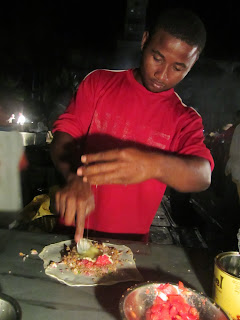 |
| Zanzibari pizza in progress |
 |
| Jack fruit |
 |
| Annatto |
 |
| Jack fruit insides |
 |
| A view from the water |
 |
| Sugar cane juicer at work |
Sunday, January 1, 2012
Mara and Mustapha's Place
Mara arrived on time. I bumped my head seven times on the dalla dalla ride to the airport. The world is not built for those who are over five foot ten. We walked across the street from the airport and drank cold Kilimanjaros before catching a taxi back to the YMCA hostel and the Holiday Inn rooftop bar across the street for a few more.
We left Mara on the rooftop while Annette and I spent a longer hour than expected on the phone to Vegas with Jennifer Henderson, getting excited about strengthening the non-profit sector in New Orleans when we get home.
We woke Wednesday morning early. Enough time to visit the fish market before our ferry to Zanzibar. At 7 a.m., the Dar Es Salaam fish market is a hive of commercial activity. People gather around vendors as the spread piles of small fish. They call in response, bills and five gallon buckets in their hands. We keep walking.
A man leads us around as we marvel at fish the length of our legs. Tuna fish. Red Snapper. Parrot fish. Octopus. Squid. Prawns of all sizes. King fish. Grouper. The man poses each fish for our camera. He asks us if we want to buy some. We explain we have nowhere to cook it. He motions at some stands across the street and says they will cook it. So, we walk across the street to find woks four feet across cooking huge vats of fish over charcoal fires. One is red, a pile of red octopus, slightly larger than my fist steam on the table next to it. We discuss what the red liquid is in the pot and why it is red. Is it red oil? Is it a dye the octopus releases? Is it seasoning? Crawfish, crabs, lobster and shrimp all change color when they cook. But mostly they don't change the color of the water. Mara is intrigued by the octopus but opts out of octopus for breakfast. Perhaps another day.
So, we walk on. Past stacks of fruit. Tomatoes. Curries and spices. Red peppers being crushed. Jars of pepper sauce. Huge breadfruit that look like the offspring of a watermelon and a porcupine. Finally, we approach some women who are cooking. They direct us to a seat. We order fish soup with chapati. It is brothy but delicious. We scoop small pieces of fish onto torn pieces of chapati bread. The chapati brings out the flavor of the fish.
By 9 a.m., we are at the Kilimanjaro booking office buying tickets on the noon slow ferry to Zanzibar. Here in Tanzania, everything is named Kilimanjaro. The mountain. The water. The beer. The ferry. The tickets say VIP on them, which turns out to be a semi air-conditioned upstairs lounge on the ferry. It has comfy chairs and not enough air conditioning. In eight months of traveling, I have learned that most of the time windows that open are better than air conditioning. But we are happy to be on the ferry to Zanzibar. Just the name elicits images of Arabic castles, exotic spices and a distant tropical paradise. Any name that starts with a z has a head start when it comes to piquing my imagination. Zebras. Zimbabwe. Zygotes. Xylophones. Ok, maybe that one is cheating. But X has a similar allure. But X isn't as smooth as Z. And most of the places that start with x are in China, which we won't be visiting on this trip.
Zanzibar slowly approaches on our port side. The sands are white. The water torquoise. Stone Town looks colonial and old, filled with mystery. And there is a big tree on the shore. It is marked in the Lonely Planet map as “big tree” with a small dot, but I don't notice this until we have already walked by it going the wrong direction. The guidebook tells us to expect chaos from touts when the ferry lands. But it is far less than the bus station in Essaouira, or anywhere in Morocco for that matter. So, we present yellow cards to customs, get a stamp on our passport, and motor through the touts offering us accommodation and taxi rides. Unfortunately, in most of Africa, they all try to become our friends first. So, the conversation goes through “What is your name, where are you from, how long have you been here, and where are you staying,” before he gets around to what he is offering. It is tiring and repetitive. A good newspaper story can capture all these basics in the first paragraph. It takes these guys a page to get there. But, as the Lion King made famous, “hakuna matata... no worries.”
We find a street vendor with mishikaka (beef kabobs) that are miniscule, fries, plantains, samosa and chicken. We eat various combinations of these for a few bucks before wandering through the transport stand in search of a 324 bus that will take us to the Rasta backpackers resort called Mustapha's Place. When I sent Mara to the website, she was sold on the subject of the first sentence, which starts, “Mustapha and his friend Culture.” No predicate necessary.
The dalla dalla cost more than it should and took a ridiculously long time, but fortunately less time than expected. But it dropped us off at the wrong place. As we pulled our packs from the back, next to a huge fishtail sticking out of a cardboard box, the dalla dalla money taker insisted this driveway leads to Mustapha's. We walked it to find the Blue Lagoon. Absolutely beautiful clear water lapping at white sands. But not our place. A taxi tried to get us for $20 to drive us five kilometers so we walked back to the road to hitch.
Sure enough the red dalla dalla drives by in a matter of seconds. It stops. The three of us yell at him about dropping us off at the wrong place. He flashes a smile and a bit more laughter than seems appropriate. But he helps us put our bags in the back and tells us to get in. We have one passenger try to call the place, but the number doesn't work. After some discussion by nearly all of the passengers in Swahili, it is decided that he now knows where to drop us. Five kilometers up, we stop. He says this is the place. We should walk down that road there. He asks a man to escort us. I see the red shipping container-turned-corner store behind a thatched porch that was described to me in the directions. So, we let the dalla dalla go and follow the young man as he leads us briskly to Mustapha's.
We left Mara on the rooftop while Annette and I spent a longer hour than expected on the phone to Vegas with Jennifer Henderson, getting excited about strengthening the non-profit sector in New Orleans when we get home.
We woke Wednesday morning early. Enough time to visit the fish market before our ferry to Zanzibar. At 7 a.m., the Dar Es Salaam fish market is a hive of commercial activity. People gather around vendors as the spread piles of small fish. They call in response, bills and five gallon buckets in their hands. We keep walking.
A man leads us around as we marvel at fish the length of our legs. Tuna fish. Red Snapper. Parrot fish. Octopus. Squid. Prawns of all sizes. King fish. Grouper. The man poses each fish for our camera. He asks us if we want to buy some. We explain we have nowhere to cook it. He motions at some stands across the street and says they will cook it. So, we walk across the street to find woks four feet across cooking huge vats of fish over charcoal fires. One is red, a pile of red octopus, slightly larger than my fist steam on the table next to it. We discuss what the red liquid is in the pot and why it is red. Is it red oil? Is it a dye the octopus releases? Is it seasoning? Crawfish, crabs, lobster and shrimp all change color when they cook. But mostly they don't change the color of the water. Mara is intrigued by the octopus but opts out of octopus for breakfast. Perhaps another day.
So, we walk on. Past stacks of fruit. Tomatoes. Curries and spices. Red peppers being crushed. Jars of pepper sauce. Huge breadfruit that look like the offspring of a watermelon and a porcupine. Finally, we approach some women who are cooking. They direct us to a seat. We order fish soup with chapati. It is brothy but delicious. We scoop small pieces of fish onto torn pieces of chapati bread. The chapati brings out the flavor of the fish.
By 9 a.m., we are at the Kilimanjaro booking office buying tickets on the noon slow ferry to Zanzibar. Here in Tanzania, everything is named Kilimanjaro. The mountain. The water. The beer. The ferry. The tickets say VIP on them, which turns out to be a semi air-conditioned upstairs lounge on the ferry. It has comfy chairs and not enough air conditioning. In eight months of traveling, I have learned that most of the time windows that open are better than air conditioning. But we are happy to be on the ferry to Zanzibar. Just the name elicits images of Arabic castles, exotic spices and a distant tropical paradise. Any name that starts with a z has a head start when it comes to piquing my imagination. Zebras. Zimbabwe. Zygotes. Xylophones. Ok, maybe that one is cheating. But X has a similar allure. But X isn't as smooth as Z. And most of the places that start with x are in China, which we won't be visiting on this trip.
Zanzibar slowly approaches on our port side. The sands are white. The water torquoise. Stone Town looks colonial and old, filled with mystery. And there is a big tree on the shore. It is marked in the Lonely Planet map as “big tree” with a small dot, but I don't notice this until we have already walked by it going the wrong direction. The guidebook tells us to expect chaos from touts when the ferry lands. But it is far less than the bus station in Essaouira, or anywhere in Morocco for that matter. So, we present yellow cards to customs, get a stamp on our passport, and motor through the touts offering us accommodation and taxi rides. Unfortunately, in most of Africa, they all try to become our friends first. So, the conversation goes through “What is your name, where are you from, how long have you been here, and where are you staying,” before he gets around to what he is offering. It is tiring and repetitive. A good newspaper story can capture all these basics in the first paragraph. It takes these guys a page to get there. But, as the Lion King made famous, “hakuna matata... no worries.”
We find a street vendor with mishikaka (beef kabobs) that are miniscule, fries, plantains, samosa and chicken. We eat various combinations of these for a few bucks before wandering through the transport stand in search of a 324 bus that will take us to the Rasta backpackers resort called Mustapha's Place. When I sent Mara to the website, she was sold on the subject of the first sentence, which starts, “Mustapha and his friend Culture.” No predicate necessary.
The dalla dalla cost more than it should and took a ridiculously long time, but fortunately less time than expected. But it dropped us off at the wrong place. As we pulled our packs from the back, next to a huge fishtail sticking out of a cardboard box, the dalla dalla money taker insisted this driveway leads to Mustapha's. We walked it to find the Blue Lagoon. Absolutely beautiful clear water lapping at white sands. But not our place. A taxi tried to get us for $20 to drive us five kilometers so we walked back to the road to hitch.
Sure enough the red dalla dalla drives by in a matter of seconds. It stops. The three of us yell at him about dropping us off at the wrong place. He flashes a smile and a bit more laughter than seems appropriate. But he helps us put our bags in the back and tells us to get in. We have one passenger try to call the place, but the number doesn't work. After some discussion by nearly all of the passengers in Swahili, it is decided that he now knows where to drop us. Five kilometers up, we stop. He says this is the place. We should walk down that road there. He asks a man to escort us. I see the red shipping container-turned-corner store behind a thatched porch that was described to me in the directions. So, we let the dalla dalla go and follow the young man as he leads us briskly to Mustapha's.
 |
| Sunrise at Mustapha's |
Tuesday, December 27, 2011
Leaving Malawi
We arrive at the Mzuzu bus station a few minutes after 11 p.m. after a Christmas with one thousand drunk Malawians at the Nkhata Bay beach. Moses and Jenipher drop us off in his shiny gold eight-seater Ford Expedition. The station is a gladiatorial amphitheater of a place. Ten steep steps surround a bus staging area on two sides, gates on the other two for combatants to enter and be dragged away. A few empty buses sleep on the arena floor. A cluster of long distance Christmas travelers sprawl along the steps. Some are stretched out sleeping. Others drinking sodas and talking. Maybe fifteen or twenty in all. Unidentified sacks of cargo obscure the entrance to the Taqwa bus booking office. I presume they are filled with corn, rice or sugar, and that they will ride underneath us to Dar Es Salaam.
We drink Fanta, play Skippo, and stretch legs in anticipation of another long bus journey while we wait. Around 1 a.m., a man tells us we nee to go around the corner to the Kotota Filling Station. The bus is there. Annette leads the pack, anxious to secure two seats next to each other on a bus without assigned seats. “Mohamed Coach Livery,” the ticket says. “IN ALLAH WE TRUST” is written on the back in large capital letters. It is an orange bus with “Bismillah” written across the top of the windshield. The seats are red an comfortable. The interior lights are red, green and blue, making it feel as much club as mode of transport. After two failed attempts, Annette gets a nine-year-old boy to move so we can sit together. The seats don't recline. There is no air conditioning, but the windows open. The bus is dark. We both doze in and out of sleep for the next several hours as we wind through the mountains to Songwe, Malawi's most major northern border.
We arrive at the border after a typically early Malawian dawn. It's a few minutes before 5:30 a.m. I say no to the steady stream of black market money changers, piss on a tree, and strike up a conversation with the two other white guys on the bus. One is Brazilian and lives in Seattle. The other is from Minnesota and on vacation from the Peace Corps in Uganda. With Annette's prompting, I brush my teeth. The border doesn't open for another hour, so we play some more cards. We pull through the Malawian side, one more stamp on our passports, a few minutes after 7 a.m.
The Tanzanian side requires Visas. And, for some reason, the bus crew decides to rotate all of the bus' tires. I change kwacha for Tanzanian schillings, (multiplying by ten in my head, despite an exchange rate of six), spend fifty cents on a breakfast of fried dough balls, and wait. I think about our time in Malawi.
Between the mountains and the lake, it is an absolutely beautiful country. And rainy season didn't amount to much while we were there. Just a few brief storms and some refreshingly cool overcast days. Parts of days, really. Our time there was mostly shaped by our last four days with Moses in Mzuzu. He is a recognized civil society leader, maybe in his late 30s or early 40s. He is definitely a member of the small educated Malawian elite in one of the poorest countries in Africa. Despite the fuel crisis, we spend a portion of every day riding around in his SUV with the windows open and air conditioning blasting. He doesn't have to wait in line for fuel. He has a staff member at work that does it, and gets his personal supply then too. He does, however, have to use his mouth to create a vacuum when siphoning food from the 55 gallon drum he keeps at the house into his Ford.
We spend an even greater portion of each day drinking and rubbing shoulders with the Malawian elite at the country club. It is a nine-hole golf club, but nobody seems to even know how to play golf there. Instead, they drink Jameson and water and talk politics. And talking politics mostly consists of criticizing the current regime. The mood ranges from cynicism and drunken depression to optimism accompanied by elaborate plans for regime change. These in a whisper of course, despite the fact that everybody in the club feels the same.
The conversation is interesting, although tiring after a few days. We joke that Moses one day may be president of Malawi. We joke, but the brains and ambition are definitely there. And, perhaps, the networks. Inevitably, as the nights wear on, the conversation gets more colorful and comical, complete with the inane ramblings of a few old important drunk men. Sometimes on the subject of the recently passed Chief Justice whose funeral we just attended. Sometimes on the state of the country and its economy. Sometimes, just inane babble. Often invitations for us to move to Malawi. And it is almost all men. A bit too much unchecked chauvinistic testosterone for me at times.
We pull off again a few minutes after 9:30 a.m. Malawi's lush mountains continue into Tanzania outside the bus window. It starts to rain as we pass a crane unsuccessfully trying to tug a truck out of a ditch off the side of the road. A man disconnects the chain from the back of the truck and covers his head with a piece of cardboard. After Mbeya, the rain clears. The mountains become high plateau. A waterfall cascades in the distance, a streak of white the length of a hillside. I imagine lions and leopards but only see an occasional cow or goat. And lots of hoed rows in various stages of sprouting. We eat bananas, oranges, peanuts and wafers we buy through the bus window. I dream of Zanzibar. And water we can swim in without worrying about bihlazia. And the arrival of our Christmas present—my sister—in Dar Es Salaam tomorrow.
I make it through most of the battery life and a large portion of the 12,438 songs on my Ipod on shuffle before we arrive in Dar. It is 2:30 a.m. when we wake the woman at reception at the Dar Es Salaam YMCA. But there are rooms available. And anything is better than that bus.
We drink Fanta, play Skippo, and stretch legs in anticipation of another long bus journey while we wait. Around 1 a.m., a man tells us we nee to go around the corner to the Kotota Filling Station. The bus is there. Annette leads the pack, anxious to secure two seats next to each other on a bus without assigned seats. “Mohamed Coach Livery,” the ticket says. “IN ALLAH WE TRUST” is written on the back in large capital letters. It is an orange bus with “Bismillah” written across the top of the windshield. The seats are red an comfortable. The interior lights are red, green and blue, making it feel as much club as mode of transport. After two failed attempts, Annette gets a nine-year-old boy to move so we can sit together. The seats don't recline. There is no air conditioning, but the windows open. The bus is dark. We both doze in and out of sleep for the next several hours as we wind through the mountains to Songwe, Malawi's most major northern border.
We arrive at the border after a typically early Malawian dawn. It's a few minutes before 5:30 a.m. I say no to the steady stream of black market money changers, piss on a tree, and strike up a conversation with the two other white guys on the bus. One is Brazilian and lives in Seattle. The other is from Minnesota and on vacation from the Peace Corps in Uganda. With Annette's prompting, I brush my teeth. The border doesn't open for another hour, so we play some more cards. We pull through the Malawian side, one more stamp on our passports, a few minutes after 7 a.m.
The Tanzanian side requires Visas. And, for some reason, the bus crew decides to rotate all of the bus' tires. I change kwacha for Tanzanian schillings, (multiplying by ten in my head, despite an exchange rate of six), spend fifty cents on a breakfast of fried dough balls, and wait. I think about our time in Malawi.
Between the mountains and the lake, it is an absolutely beautiful country. And rainy season didn't amount to much while we were there. Just a few brief storms and some refreshingly cool overcast days. Parts of days, really. Our time there was mostly shaped by our last four days with Moses in Mzuzu. He is a recognized civil society leader, maybe in his late 30s or early 40s. He is definitely a member of the small educated Malawian elite in one of the poorest countries in Africa. Despite the fuel crisis, we spend a portion of every day riding around in his SUV with the windows open and air conditioning blasting. He doesn't have to wait in line for fuel. He has a staff member at work that does it, and gets his personal supply then too. He does, however, have to use his mouth to create a vacuum when siphoning food from the 55 gallon drum he keeps at the house into his Ford.
We spend an even greater portion of each day drinking and rubbing shoulders with the Malawian elite at the country club. It is a nine-hole golf club, but nobody seems to even know how to play golf there. Instead, they drink Jameson and water and talk politics. And talking politics mostly consists of criticizing the current regime. The mood ranges from cynicism and drunken depression to optimism accompanied by elaborate plans for regime change. These in a whisper of course, despite the fact that everybody in the club feels the same.
The conversation is interesting, although tiring after a few days. We joke that Moses one day may be president of Malawi. We joke, but the brains and ambition are definitely there. And, perhaps, the networks. Inevitably, as the nights wear on, the conversation gets more colorful and comical, complete with the inane ramblings of a few old important drunk men. Sometimes on the subject of the recently passed Chief Justice whose funeral we just attended. Sometimes on the state of the country and its economy. Sometimes, just inane babble. Often invitations for us to move to Malawi. And it is almost all men. A bit too much unchecked chauvinistic testosterone for me at times.
We pull off again a few minutes after 9:30 a.m. Malawi's lush mountains continue into Tanzania outside the bus window. It starts to rain as we pass a crane unsuccessfully trying to tug a truck out of a ditch off the side of the road. A man disconnects the chain from the back of the truck and covers his head with a piece of cardboard. After Mbeya, the rain clears. The mountains become high plateau. A waterfall cascades in the distance, a streak of white the length of a hillside. I imagine lions and leopards but only see an occasional cow or goat. And lots of hoed rows in various stages of sprouting. We eat bananas, oranges, peanuts and wafers we buy through the bus window. I dream of Zanzibar. And water we can swim in without worrying about bihlazia. And the arrival of our Christmas present—my sister—in Dar Es Salaam tomorrow.
I make it through most of the battery life and a large portion of the 12,438 songs on my Ipod on shuffle before we arrive in Dar. It is 2:30 a.m. when we wake the woman at reception at the Dar Es Salaam YMCA. But there are rooms available. And anything is better than that bus.
Friday, December 23, 2011
Mango Season
 |
| Bumpy back-of-the-truck view. |
Annette finally got an affirmative answer to the question she gives new travelers: Can you teach us a new card game? The game is Skippo. And we ended up following the two Dutch sisters who taught it to us to Nkotakota to play it some more. We rode in the back of a truck amidst the stream of travelers and livestock heading home for the holidays. In addition to lots of people, supplies and children in the backs of trucks, the holidays brought buckets of fish, huge catfish tied together with reeds, goats strapped to the backs of bicycles, and babies holding chickens. In Malawi, Santa drives a matola. I presume this steady stream of live animals is headed to slaughter for Christmas feasts.
Morning comes early in Malawi. The sun rises by 5:30 a.m. We leave the Anglican Church guest house in Nkotakota for breakfast and another truck to three-minibuses in order to get to Mzuzu. The ride gets better as we go. Tiny yellow mangoes are messy and sweet as can be. They are everywhere on the roadside. Kids count the number of people in the back of the truck as we pass. First it is fifteen. It reaches 25 at its height. And there is no shelter from the sun. But, soon enough, we are shepherded into a mini-bus with Lucius Banda tunes bumping. Good Malawian reggae/high-life sounds. Sweet mangoes. Windy mountain roads. Sweeping views of the clear waters of Lake Malawi. Temperatures cooling. Life is good.
By sunset, we are on the doorstep of the Church and Society office in Mzuzu, welcomed by Moses. We ate catfish with him back in New Orleans last April when he was visiting as part of a delegation sponsored by the State Department. Annette kept in touch. So, now we ride in his Ford Expedition passed gas lines that block one direction of traffic down the main street of Mzuzu. We end up at “The Club,” as he calls it. It’s a country club frequented by the movers and shakers of Mzuzu. We are introduced to entrepreneurs, politicians, civil society leaders, professors. The crowd gets more raucous, the conversation more lively as the drinks flow and the night wears on.
The professor professes to us that he is a failure, a lowly university lecturer, because he doesn’t feel that he is producing the students who can lead Malawi to the future. Dan the politician explains the challenges with the current regime and his strategies to bring the opposition to power and lead a unified government. There should be a press conference today on the subject. Meanwhile Moses plans the Saturday’s funeral for a recently-passed Chief Justice with a few gentlemen at the bar.
I pitch the idea of collecting used cooking oil from the roadside chips stands and converting it to biodiesel. It is novel idea here. And needed, given the fuel crisis and Malawi’s dependence on foreign imports of fuel, tourists and everything else but corn, tomatoes and mangoes. Moses reiterates his April invitation for us to move to Malawi. And the idea is appealing. Biodiesel could work here.
The Harlot of Blantyre


12/13/2011 (during our long bus ride)
Life fade beyond the horizon, leaving us as our only friends.
Through the darkness a new life is dawning,
she is my beginning she's my end.
Through the darkness a new life is dawning,
she is my beginning she's my end.
With steps wider than oceans and the stars our only plan
we will scan the depths of our devotion
and receive what comes with open hands.
Patience with her perfect balance
shifts underfoot as distant sands,
in our souls we long for creation
pink mountains, teal ripples,
tiny fingers grasp for knowing hand.
12/20/2011
Malawi reminds me that resources are finite, not just petro and clean drinking water here, but all over the world. Before we arrived into the southern region's lush rainy season we were warned that transport across the country would be challenging because international support in the form of foreign exchange (forex) had been cut, and there are widespread oil shortages. It is a difficult thing to enter a new place with its own memory, languages, conservative values, history and to claim to understand the political climate. The expats in S. Africa warned that Malawi was in danger of turning into Zimbabwe with its hopelessly corrupt politicians and waste, a modern day failed state. The only Malawian take we got on the subject so far came from a milk chocolate girl who works on a “tourist island” in Cape Maclear. She had a shaved head, tatoos, and a smattering of unidentified piercings to match her British tinged accent. Unfortunately, I lost most of her drunken banter under the disapproving mumbling of her fellow vacationers an Afrikaaner expat and an Irish nurse.
Malawi reminds me that resources are finite, not just petro and clean drinking water here, but all over the world. Before we arrived into the southern region's lush rainy season we were warned that transport across the country would be challenging because international support in the form of foreign exchange (forex) had been cut, and there are widespread oil shortages. It is a difficult thing to enter a new place with its own memory, languages, conservative values, history and to claim to understand the political climate. The expats in S. Africa warned that Malawi was in danger of turning into Zimbabwe with its hopelessly corrupt politicians and waste, a modern day failed state. The only Malawian take we got on the subject so far came from a milk chocolate girl who works on a “tourist island” in Cape Maclear. She had a shaved head, tatoos, and a smattering of unidentified piercings to match her British tinged accent. Unfortunately, I lost most of her drunken banter under the disapproving mumbling of her fellow vacationers an Afrikaaner expat and an Irish nurse.
We arrived in Blantyre after a 38 hour bus ride, that despite an acceptable amount of drama and several tedious border/immigration check points, was very comfortable and a good ride. I read all 400 pages of Anita Diamante's first novel “The Red Tent,” a historical fiction account of the life of Dinah, the daughter of the biblical figure Jacob the Cannanite, the father of Joseph with his multicolored robe whose brothers sold him into slavery not unknowing that one day he would be a king. I wish to be able to weave a story together like this. To master the art that makes the shapes of worlds and the faces of children appear vividly in a readers' mind. I know the very basics from my work, that every story has a beginning, middle, and end. But I am truly envious of those writers who can skillfully deconstruct the pieces and create a patchwork that warms the creative spirit with each turn of the page. I imagine once our trip is over, writing a book using these blog entries (and some private journaling) and tackfully weaving in the stories of our families, how the romance of Vicki and Tony sparked in Marrakesh, love at first sight when my dad caught my 9 year old mom stealing a watermelon from his family's patch. Their stories are our own.
In Blantyre we CouchSurfed with Elaine an English teacher from the U.K. In her mid-50s. Her spacious apartment was sunny, comfortable, and minimally decorated with a few Indian scarves draped across windows, an tapestries depicting women in the marketplace or farming decorated the walls. She immediately offered us beers and real french bread with olive oil, fresh tomatoes, cucumbers, celery, 2 types of cheese, olives, and balsalmic vinegar. We ate our fill and enjoyed her easy conversation for another hour or so before heading to bed.
The next morning I awoke early to find Elaine sitting off the back porch outside our room reading a book and smoking a cigarette, she has only taken up smoking this year and intends to stop for the new year. I join her and delve into my newest addiction by Chimamanda Ngozi Adichie, “Half of a Yellow Sun” a novel about love, family, and the Biafran war in Nigeria in the 1960s. A few hours later Ham and I decide to make the 20 minute walk into town to explore on foot, our time honored tradition that has gone a bit neglected over the last month or so.
By 10am the air was already steamy and I opted to wear my billowing blue shirt-dress that falls a few inches above my knees, a cheap purchase in Madrid on a day where each of us needed some alone time. For good measure I threw on my black shorts underneath. It wasn't long before I realized that all of the people we walked past along the way had their eyes transfixed on my bare legs. I had not heeded the suttle guidebook warning that Malawians are a bit conservative. I had wrongly assumed that in a place where it is common to see the bare breast of women bathing or feeding children, my bare legs would be no big offense. I was wrong. For a couple of hours that felt like an eternity we walked through town, stopping at the delicious Indian owned vegetarian restaurant Veg Delight. Even after the power went out shortly after our arrival I was still grateful to eat a tasty dossa stuffed with spicy potatoes, my sweaty legs sticking to the chair, momentarily free from the accusing glares of the women on the street.
“You are dressing very smart sister,” a sarcastic compliment from a passerby. Once we were in the city center I swear there were a couple of blocks where all the men sitting grouped on steps in front of stores all stopped talking, their entire heads following my every move. Then it happened, someone started to whistle, the shrill sound pierced the air and traveled up the length of the block as others also sounded the alarm, the Harlot of Blantyre is passing! At some point we ducked into a grocery store to survey the unappetizing packaged food, poorly refridgerated meats, and long life milk stored in cartons on hot shelves. We found an on site internet cafe and passed an hour on fantasy football, facebook, an CouchSurfing. The oscilating fan was quite pleasant until young man sat in front of it, the air stream blowing the familiar stench of body odor over us all.
Once again we were out the door, in search of a market that Elaine described as worth seeing. With a little guidance we found our way there and quickly walked through the stalls of second hand clothes, fresh fruits and vegetables. By the time we reached the hardward aisle and food vendors I was quickly scrambling past various animal intestines being grilled next to fryings pots of potatoes. The hawkers, mostly men, were smiling and staring, murmuring things like 'black-American' and other phrases in other languages. The discomfort was almost unbearable. I quickly led Hamilton out of the market and we started walking uphill in a direction that I hoped would lead us back home. This final stretch on the outskirts of the market was filled with women sitting on the ground in the shade and hawking miscallaneous goods repetitive of all of those we had just seen. They jeered at me, and then it happened again! A woman started ululating, and howling loudly, as if annoucing "her she comes in all of her boldness!" It felt as if each person we passed after that participated as well, other women offering up their loud wails with smirks on their faces, and the now familiar secession of whistles from the men. At one point Hamilton turned to me, astonishment splashed across his face, asking "is that all for you?" It clearly was.
Only a week later we would be walking through Nkohtakota with some new friends we met at Cape Maclear, 2 sisters from Holland braving the heat in much shorter shorts than my own and bare shoulders, their pale white legs glowing like alabaster in the sunlight. While they would be met with the expected stares received by random white people walking in the hood, there would be no big show outside of the standard hellos and eager greetings of naughty children and curious adults. This double standard leaves my mind reeling. Perhaps my judge and jury in Blantyre believed that I was Malawain, a common occurence in every African country we've visited, who was blatantly ignoring the established mores and dress code. Add my white "friend" to the mix and I definitely would look like an abomination. But what about those who assumed that I was a black American, what excuse would apply for their reception of me? Its a bit frustrating, like how the mini-taxi drivers eagerly rush to carry Hamilton's backpack to place in the back of the truck, leaving me to struggle alone with mine which is equally imposing and heavy. Hamilton was always apologetic the first few times, assuming that because he had been relieved of the weight of his pack, naturally so would I. Now he'll loudly instruct the men to "take my wife's bag" which is often ignored, until he himself comes to help me. Frankly, while I would like the help sometimes I really don't need it. African women carry far more unweilding cargo than my neatly contained (though heavy) pack. While there is a fellowship of having the same-ish skin, there is also a disregard or demotion in status in the presence of my white husband. In moments like these I revert back to my family roots, I can haul a 50 lb sack of cow feed off a truck and down to the stalls, I'm a Mississippi woman!
Hamilton started to make other suggestions for where to walk, I quickly cut him off saying that I only wanted to go home. Despite my visible embarrassment and discomfort he was still hesistant to comply, insisting on stopping at a decrepid building that had once been a cultural center to see if there were any shows coming up. There weren't. I chose to walk on a shaded dirt path that was out of sight of most of the passing cars on the road, Hamilton continued to walk on the other side of the street, not perceiving my desire for some sort of protection or shield. When we reached the turnoff for Elaine's apartment he shouted that he was going to the store, leaving me to walk the last quiet stretch alone, my Malawian walk of shame. I turned into the wrong drive way and knocked on an identical door of an identical apartment building, only to scandalize the small girl who answered the door. We laughed later on when Hamilton confessed that he made the same mistake.
That evening we walked onto the campus of Saint Andrews with Elaine to sample the homemade ginger beer and other assortments of her fellow co-workers, the husband French and the wife Scottish. While there Hamilton inquired about hiking routes in the nearby ranges, asking for directions on the best ways to get there. I already knew that I would not be walking through the city of Blantyre again. While I would not have on the same clothing, I would still be totally recognizable, I could imagine people sitting at their dinner tables that evening mentioning in passing the disgusting display they witnessed earlier that day.
When we woke up that next morning I was thankful to see that it was going to be a rainy day. We opted to pack up our bags and continue to treck on to the coolness of the Zomba Plateau. Its a shame, I really would have liked to spend more time talk with Elaine, learning about her extensive travels and the disfunctionalities of U.K. culture. But alas, the Harlot of Blantyre wears shorts and hiking boots, and these boots were made for walking.
Cape Maclear
 |
| Sunset at the bar at Fat Monkey's. |
 |
| Accacia overlooking Lake Malawi. |
 |
| Clear and tranquil waters. |
 |
| A fish eagle's eye view of the sandy stretch of paradise that is Cape Maclear. |
Without question, Malawi is best seen from the back of a truck. They call the pick up trucks that take hitchhikers everywhere in this country matolas. Matolas are the main form of transportation in this country. We caught one in Liwonde and a second one in Monkey Bay as we found our way to an isolated paradise in Cape Maclear on Sunday. We sat on boxes of donated clothes, bags of mangoes and chalk-like sweet potatoes and our backpacks. One small pickup truck carries fifteen adults and two babies comfortably. People are packed in around the cargo. The breeze is delicious. The views of mountains, villages, mighty baobab breathtaking. Children run out to meet us with chants of mozunga, chichewa for obruni, white man. Annette was tickled to be back in a place where I am recognized and greeted by children.
And Cape Maclear is paradise. We eat fresh mangoes that are sold from underneath a six hundred year-old baobab tree in the center of town. All menus have fresh seafood, which in this land of one of the largest fresh water lakes in the world, includes duck. Never mind that my first duck was tough and bony. The tiger fish baked in a banana leaf and fried chambo (catfish) easily make up for it. So does a morning kayak ride exploring the nearby islands. And a fresh mango juice to cool off.
We stay in a dorm at Fat Monkeys with six beds. The first night, we have the place to ourselves. The second, we are joined by a guy named Josh from Nashville who is teaching geography and planning at Rhodes University in South Africa. And two sisters from Holland. The Carlsberg and Khuche Khuche beer flows cheaply and keeps us cool during the days. The nights cool down enough for comfortable sleeping.
Subscribe to:
Posts (Atom)