Tuesday, November 22, 2011

Morocco in Photos


Annette at sunset over Marakesh
Snails for sale in Marakesh
The swirl of the square in Marakesh
Moroccan flag precedes the mosque for the match vs. Tanzania
The Bob Music Store in Essaouira
The sands of Essaouira
Rabat
A view from the madina in Rabat
The tomb of Hassan II and Muhammed IV, and an unfinished mosque
Every Moroccan city has a color. Blue is for most of the coastal cities.

Annette's Footsteps and the Search for Crafty

Lately, I have been feeling like we are tracing Annette's past footsteps. For me, when I look at this trip, I don't want to visit any place I have been before. When I was a child, my mom used to discourage me from reading a book twice. "There are too many good books out there," she would say. Well, the same goes for the world. The world is still too big a place at this point to go anywhere twice (except maybe India, which is a world unto itself).

It has been different for Annette. And I think it is because she is a self-described Army brat. She moved every couple of years growing up. So, for her, to revisit a place or person from years ago is a luxury, an opportunity she rarely gets. And the universe has done a good job collaborating in this effort.

This summer, we walked the halls of her senior year at Jefferson City High School. We walked to Lincoln University and the ROTC building where her father used to work. We went and found Mr. Tyus in a used cell phone shop in the back of a strip mall in Missouri. He is the father of one of her best male friends from high school, who has since moved to Mexico.

In Germany, we found her kindergarten teacher, the playground she used to swing on, the candy store she frequented. And she crouched in the little classroom fort, far too tall now to stand up straight, that her teacher so clearly remembers her loving.

In Senegal, we retraced her steps on Goree Island, where she visited with her family as a girl. And much of our month in Ghana was the same. We found some new places and old ones she visited with her parents as a girl and with Dr. Dorr and her classmates at Ole Miss six years ago. And she was so comforted when we found the elephants in the water hole she remembers in Mole National Park.

And even our new places were made old. Through couchsurfing, we found a classmate of Annette's from her last year at Jeff City. She was one year into her service with the Peace Corps in the small village of Lipke Todome, an area Annette had never been. Jeanna not only went to the same school, she graduated in the same class. But they had never met. So, while I hiked to the caves and waterfalls alongside Francis, our guide, Annette and Jeanna reminisced on Jefferson City. We stopped to let them catch up every so often, but they were fifteen years behind.

We spent a day on our way back from the Volta Region stopping in Ho in search of Crafty. Crafty was an artist she met on a Sunday during the one day she spent in Ho six years ago. She remembered a hotel across from a church and by the end of lunch we were headed that way. Then I just followed her as she walked through her memory. She led us down a street, where I stopped and told a dreadlocked woman I was looking for somebody, a man named Crafty. "Oh. I know Crafty. His shop is just down the street on the left," she responded with a bright smile. So, we walked to it and found it. But it was locked. So we called the number on it. Crafty answered. He was in a tro tro coming back from Akosombo. So, we waited. And we waited a bit longer than expected, as expected.

He arrived with a smile and took us to his house, which lives vividly in Annette's mind. For me, this part was like a movie that had been described to me and quoted too many times (like Dazed and Confused in high school). (The fact that he had given her a firm Ghanaian kiss six years ago and Annette says she wasn't impressed, didn't help). By the time I set eyes on Crafty's house, I was disappointed. It had been built up to be a castle, which it wasn't quite. But it was beautiful and artsy. He urged us to take off our shoes and relax. He brought us a plate of chopped pineapple. He keeps two live crocodiles in a back courtyard. He has a view overlooking the city. And art everywhere. Jewelry, drums, stringed instuments, clothing, beads, voodoo dolls. Indinkra symbols decorate the wall and line the hall. Reggae slips out an inside window and dances in the courtyard. Two hours was sufficient for Annette, even time for us to still catch a tro tro back to Accra that evening.

Monday, November 21, 2011

Ghana in Photos

A peacock struts while women sell plantains.

Annette tries her hand at weaving kente, an art normally reserved for men.

Visiting the kente weavers in Bonwire.

Kejetie Market in Kumasi.

Plantains frying.

A drum being carved from a single tree trunk.

A beggar on Eid.

Women dressed up for Eid.

Playing with children in Kumasi.

A game of copy cat...

Maggot-filled bucket toilet in Tamale.

Red red, plantains and tilapia at Lobodi Beach in Accra.

The Volta Region, Ghana in photos

Dressed by Crafty, Annette's old friend and artist.
Hanging with the chief of Lipke Todome after pouring libations of palm wine for our safe travels.
A couchsurfing host in Lipke Todome, Peace Corps Volunteer (and Annette's high school classmate it turns out!) Jeana
Batik prints decorate a thatched roof.
The women of Lipke Todome sew purses out of used plastic water satchels for sail, a Peace Corps economic development project.
Big sis carrying little Prince on her back.
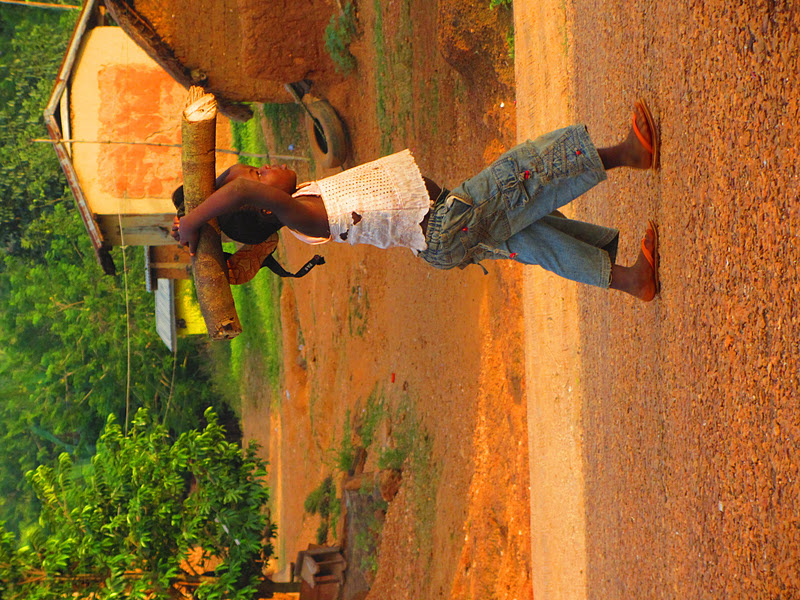
The kids start early carrying things on their heads.
Exploring ancestral caves around Lipke Todome

Motorcycle posing in Lipke Todome

The waterfall at Lipke Todome with our guide, Francis.

Eating the gooey paste around the cocoa bean, freshly picked from the tree

Annette and Jeana, high school classmates (unbeknownst to them at the time) sitting in front of the falls

Hiking along the Togo border.

Exploring the ancestral caves in which the settlers of Lipke Todome first took refuge.

Entering the chief's cave.

Annette trying not to show her fear of bats.

Tuesday, November 15, 2011

The Sounds of Ghana

“Ssssssssssss,” it sounds like the forked tongue of a snake flittering about its mouth. Or a dragonfly zooming by. In America, it would be rude. But here it is a customary communication, a way of getting somebody's attention, usually a vendor.

The tro tro driver has another tool at his disposal: the horn. He uses it to grab the attention of the pure water lady in response to her purrs and meows of “puuuuur whaaaatter.” For that, it is just enough of a “meep” to get her attention. Half of the road runner's call to Wily Coyote.

But, as we ride across Ghana, I have come to recognize that there is a whole language in car horns here. Honks of existence and identity. As if to say, “I am here.” “Greetings.” “How are you?” “Hey there. It's been a while!” They honk back and forth at each other as they pass in opposite lanes. And they honk between each other warnings of what's ahead, permission to pass, notification that they are stopping or going. I am convinced there is an entire language here. Different inflections with different meanings. A morse code of a vocabulary that I don't understand.

I have come to understand one small piece of the tro tro driver's language. It is the bang on the metal side of the vehicle. I cannot do it with the rhythm and grace of the money collecting touts that ride in the fold down seat on the side. But it tells him when to stop and when to go. That or a shrill “bus stop” hollered from the back. But even the words take on the intonations of songs. The pastor who speaks in tongues, speaks rhythms not words. And the children's chants of “obruni” are as much of a nursery rhyme as a recognition of a white man walking by.

The rhythm of this country is contained everywhere. It is in the children banging on buckets on their way home from school. The women pounding fufu. The crickets that sound like they are tapping bottles. The man cutting into a coconut with a machete. The rattling of the plantains frying in a big bowl of oil. The hiss of the opening of a cold glass bottle of Fanta. The woman grazing the edge of an orange peel off with a small knife before arranging it on display on her stand. The big metal bowls that clunk and bang everywhere. The home made drums and xylophones. Talking drums. Roaring drums. Summoning drums. Thumping drums.

The Volta Region

We have been talking about the Volta Region for weeks. It was always part of our plan for Ghana. Head west along the coast. Then north. Then east. Never mind we ended up having to detour through Accra to visit our friends at Ethiopian Airlines.

We spent Sunday afternoon and evening in Aburi, home to some colonial botanical gardens. While the hotel looks and feels like it hasn't been maintained since World War I, so do the gardens. In the case of the hotel, that is a bad thing. In the case of the gardens, it is a good thing. Even the now unreadable signs with paint peeling away from the Latin names for each tree or plant, the genus or species lost to another era in history. Parts of the medicinal and traditional uses for each tree show through occasionally. Cocoa. Nutmeg. Bamboo. Other imports as well as countless locals. We are welcomed by a stately row of two dozen royal palms on either side of the entrance that leaves us feeling like we are walking down a boulevard in Beverly Hills. But the king of them all stands covered in a robe of mature vines climbing up its trunk. About 86 feet up, a few branches pop out like arms from a tyrannosaurus rex  – meek in comparison to the creature's power. The tree is easily two hundred years old. It is a silk cotton, the last of the old growth trees here. The sign says that the tree beside it was planted in 1927. While stately, it is a young nephew of the king at best.

We wander the grounds and enjoy the cool air of the hills, the first since we arrived in Ghana. Old trees have a way of emitting a soothing energy. With a few more cedars, Aburi gardens would be as welcoming to me as the old growth cedar grove in the Bitterroot Mountains on the way to Jerry Johnson Hot Springs on the Idaho side of the border from Missoula, Montana. That, or the Olympic Mountains, with trees fit for even Ewoks to call home. But, after the red dust of Tamale and seven weeks in Africa, Aburi is a welcome substitute for those majestic cedars.

We follow a hand-painted “Peter's Pizza --->” sign just outside the entrance to the gardens. We eat dinner with Peter and Jessica. Jessica is from Barbados and does the desserts. Peter is Ghanaian via Amsterdam and years working in the kitchen of a cruise ship. He bakes pizza and buys his cheese at Shop Rite next to the Accra mall, the only place decent cheese is found commercially in Ghana, I believe. It feels like we are sitting in their living room. And we may be. There are only two tables, each with two plastic chairs. I order the spaghetti bolognaise. Annette orders the vegetable pizza. Both are made from scratch in front of us and eaten back to scratch shortly thereafter. We enjoy a long conversation to go with the meal.

Photos of black leaders of the twentieth century are mixed with family photos (also from the twentieth century) along the walls. There are two photos of a woman I don't recognize. One has her name beneath it: Madame C.J. Walker. I learn who she is from the two of them and Annette. She is essentially the founder of the black haircare industry. She was a millionaire and a philanthropist, an independent black women in an era when even white women were fighting for their independence. Seems she made her fortune in an interesting industry. Certainly she is a role model for helping birth black as its own standard of beauty. That being said, I am sure plenty of her products helped black women make their hair look like white women. I am three hundred and fifty pages into Ralph Ellison's Invisible Man and am left with more emotion and confusion about how f*$%ed up race is in the world than anything else. He leaves me questioning our heroes – all of them, not just the Columbuses.

We left Aburi with Peter's banana pancakes with honey sticking to our stomachs. A shared taxi to a tro tro to another tro tro and we were finally looking at Lake Volta, the largest man made lake in Africa. Well, not exactly. We were looking at the Volta River, just below the dam. Between Kumasi and Tamale, we crossed the Black Volta and the White Volta. Both looked brown with mud. Here the landscape is green. And the river is wide. The tro tro drops us in Atimpoku at the roundabout just before a huge modern suspension bridge that makes the rust brown I-87 bridge with an unpronounceable Polish name over the Mohawk River in upstate New York look like it is from the iron ages.

We walk up the stairs to our guidebook chosen budget hotel to find three woman sitting around the reception area. They all work here but none seem to know what is going on. Annette is unimpressed. But, eventually the young woman in an orange shirt and spandex tight dark jeans shows us a room. I ask her for the cheapest. It is thirty cedis, with a fan and private bathroom. And bright electric blue walls. And, when night comes, I discover it has a black light instead of a regular light. I need my headlamp to hang the mosquito net. But the green Petzl logo on the band glows in the dark.

After some effort, we call another hotel. The phone exchanges across all of Ghana changed a few years ago. So, the phone numbers everywhere are wrong. On billboards, business cards, in our guide books. They are only good if we can find out what the new exchange is for the region. We learned it for Accra after some effort.. I asked for the one for Aburi in Accra before we left. Nobody knew. Now, nobody even knows the number of the hotel here. Finally, a young woman gets another young woman who writes 03430 on a slip of paper and delivers it to me. This is the substitute for the 0251 that the guidebook has. I reach the other guidebook recommended hotel, but the price is the same and it is further from town. Annette and I argue a bit. Finally we drop our bags in one of the staff rooms of the hotel and go to explore the river. We walk across the extension bridge, snap a few photos, continue our argument. At our rehearsal dinner, my good friend Allen told me us, “marriage is an agreement to argue.” At the time, it sounded crazy and out of place. But he is right, marriage is an agreement to argue and still sleep under the same mosquito net.

So, after arguing on both sides of the Volta River, pausing for satchels of pure water and bouncing back across the suspension bridge, we go. We catch a car to Akosombo, which deposits us at a market in the middle of town. No dam in sight. No river in sight. The taxi driver offers to take us to the dam for ten cedis. We refuse.

We get out and follow the shade to the right then the left. The houses have the look of military housing for American enlisted men. Concrete homes, two by two. It is government housing. Built by the Volta River Authority, I presume. Neither Akosombo nor its dam, nor the lake itself would exist without it. And the government is proud of it. We end up walking residential streets until we find a group of school children clustered around two women with babies wrapped on their backs. I ask one of them about how to get to the lake. She explains we need to take another taxi to Mess. So, we do.

The taxi drops us at the Volta Hotel on a hill overlooking the Akosombo Dam. The dam is impressive. It has an island in the middle of it. It winds a few kilometers around two edges of the lake, forming a huge capital S, Garamond font with the edges curled a bit. We snap a few photos and admire the hotel pool. Annette points out sullenly that we aren't going to eat in the restaurant and we aren't going to stay here, so why look? So, we head back down the hill to catch a shared taxi back to Akosombo. There we meet a young woman getting off work from the hotel. A gray Japanese model car pulls up to the stop sign. A guy in a chef's outfit calls out the window to ask us where we are going. “Market,” the young woman says. “Get in,” he responds. “Us too?” I ask. “Yes.” It is a comfortable and free ride to the market, where we find a shared taxi back to Atimpoku.

We fetch our bags and reluctantly check into the hotel. We head for the Internet Cafe where I am pleased to learn the Saints beat the Falcons in Atlanta in overtime, due in part to a bad call by the Falcons' silver-haired coach. For now, the Saints stand firmly atop the NFC South. Watching some of these games is on the lengthy list of things I will do once we make it to South Africa. I send some e-mails, eat, look into boat rentals on the river and return to the hotel at dusk to discover our room's light is blue. I write a bit, shower a refreshingly cold no-shampoo shower. (Buying shampoo is also on the list of things I will do once we get to South Africa....or perhaps in the Accra Mall, since the best I have been able to find even in the most touristy of areas is Johnson & Johnson's baby shampoo).

I walk to send a few more e-mails at dusk. But the Internet Cafe next door is closed. I walk in search of fried yam, which basically involves crossing the street. I am greeted by calls of “obruni”: white man. Usually, it is the kids who say it, chant it, or sing it even. “Oooobruni, obruuuuni,” they call in enthusiastic choirs as I walk by. They always smile when they say it. It is not derogatory, just a bit naughty. Since Cape Coast, it has become Annette's favorite song.

I walk through the market, which also seems to be a tro tro/taxi station. Mostly bread is for sale. It never fails to amaze me how many people can sell the exact same thing right next to each other and all remain in business. Women have torches lit on their trays with fish and chicken displayed for sale by the piece. They look like big citronella candles. Minus the headlights of occasional passing cars, the torches are the only light in the market. “Obruni,” even old women call as they see me approaching. They say it as a word of recognition. A greeting. It leaves me feeling like the mayor walking through town, always greeted by my title, rather than my name. I wave hello in response. Back in Agogo, when the kids would sing it, sometimes I would dance. Sometimes I respond, “bibini:” black man. But that doesn't feel right. So, mostly I smile and wave or say hello. What else can I do?
I find Annette at a second Internet Cafe. This one is still open. It is run by a black man from Virginia. I recognize his accent as American immediately. Annette says the government of Ghana has provided land not far from here for any African-American wishing to move to Ghana. And that he built a house for 5,000 Ghana cedis, where he lives with his mom. He has four big color televisions and some Playstations out front for the children. The stars are out above us. The Volta lurks behind it all, peacefully and quietly. It occupies a world different from this street, but deeply connected. Perhaps tomorrow, we will explore it further.

A beautiful cedar tree in Aburi.

Annette impersonating the ivy-covered t-rex of silk cotton trees.

The lush Volta River.

Sunday, November 13, 2011

The Return to Accra

We wake up at 3:30 a.m. Friday morning under a cool full moon to say goodbye to the elephants, monkeys and warthogs of Mole National Park. Apparently, they aren't much for goodbyes. I don't see any of them anywhere. Only a huge orange Metro Mass Transit bus the size of two elephants standing trunk to butt. It is lurking outside the Information Center. We ride it off at 4:23 a.m.

We spend the day tracing a huge Z across Ghana. The road home is always easier and quicker than the road there. We watch the sun rise over clusters of small circular huts with grass roofs, fences of vertical wooden branches separating the fields of corn, goat and cow from the village. The chickens and guinea fowl roam where they please.

We arrive in Tamale before 9 a.m. Tamayalele, as Rafik had explained, means place of the kola nut. When the colonialists arrived, the locals often said they were going to Tamayalele. The colonialists picked it up as Tamale. Already, the heat is building, like in an oven that has begun to pre-heat to bake the day's bread. We buy a ticket on the next scheduled bus to Accra, which departs at 7 p.m. It is an expensive but relatively comfortable 12-hour ride. It would save us a night in a hotel, though, I rationalize.

Soon, seven of our fellow German and Austrian passengers from the morning's bus emerge to buy tickets. They must have asked the question of the ticket lady differently. They must have asked for the “next” bus to Accra. Because lo and behold a bus is arriving at 11 a.m. from Bolgatanga, near the Burkina border, with empty seats. And it is headed to Accra. So, we change our tickets.

The bus takes us from Tamale back through Kumasi. We stop outside of Kumasi for banku and okra stew. Banku is a soft ball of pounded maize and millet, I think. The okra stew is thick featuring three chunks of meat that seems to be beef wrapped around cartilage and coated in skin. I eat it with my right hand, freshly washed in soap and a bowl of water that is customarily provided for people who order fufu, banku or other foods eaten with the right hand.

We board the bus again with full stomachs to continue tracing the end of the alphabet in the Ghanaian dirt as it changes from red to brown. Annette convinces the bus driver to put in our 20 in 1 DVD. We watch One Love (another bad Kymani Marley movie with a good soundtrack) and City of God, dozing in and out. By 11 p.m., we find ourselves in a line of trucks and buses on a dirt road, averaging 20 km per hour. We spend a long and bumpy hour on this road before the lights and well-signed paved roads of Accra emerge before us. The bus finally drops us at Nkrumah Circle in Accra close to 1:30 a.m.

We walk the one kilometer to the New Haven Hotel. It is Friday night. Accra is quiet. Other than honking cab drivers looking to pick up these two foreigners with backpacks for a hefty fee, there isn't much selling. The staff at the New Haven Hotel seems to have amnesia. The reservation I made by phone around 9 a.m. this morning is nowhere to be found. There is one empty room. It is for a man named James, who reserved weeks ago. Given that he isn't here and it is 2 a.m., it doesn't take much to convince the sleepy staff member to give us that room.

We hit the bed after 2 a.m. to sleep off our longest day of travel yet.

We wake up to an Accra that seems different than the one we left two weeks ago. Travel around Ghana toughened us up a bit, I suppose. We were deer in headlights when the tro tro dropped us off near bustling Kejetie Market, supposedly the largest in West Africa, in Kumasi only ten days ago. But, within days we learned to navigate it. Now, the puzzle of the tro tros of Accra seem easy to navigate.

After a prolonged hotel breakfast of toast and tea, we catch a tro tro to Nkrumah Avenue and another to the Ethiopian Airlines office. I am in a foul mood and prepared for a fight.

After visiting travel agents that quoted us ticket prices over $700 a pop to South Africa, we went online. This was a week ago in Kumasi. We found tickets on Ethiopian Airlines for $500 each to Johannesburg. After the server bumped me off multiple times, I completed the reservation to find that I could not pay online. I could only pay in person in Accra. And I had to do it within 48 hours, or else the tickets would be canceled. I tried to call their main office in the U.S. and Ethiopia via Skype but the connection was bad. I even had my dad try to call Ethiopian Airlines in the United States to make payment. But all he found was a brick wall. So, I called Ethiopian Airlines in Accra multiple times this week. Mostly they didn't answer the phone. But when they did, one agent told me not to worry, the ticket would still be available. Another told me the opposite. And a third told me they are open until noon on Saturdays. So, like most things, this would need to be sorted out in person.

We are third in line. There are four desks with computers. Only two are occupied by agents, but the woman occupying the desk to the right disappears shortly after our arrival. After a grumpy 25 minutes, Annette and I take a seat across from the male agent. He asks us to hold on while he deals with a young man with two bags of bread. He puts the two loaves of bread in a larger bag and pays the man a few cedis. I explain that we are here to pay for a ticket that we booked online. I hand him a scrap of paper with the six digit reservation confirmation code underlined. The phone rings. He answers it. He taps at his computer, writes some things down on a piece of paper, reads letters and numbers through the phone. I am not sure if they are dates or prices.

After five minutes, he hangs up and returns to the sullen customers in front of him. “The system has canceled this reservation because you did not pay within 48 hours. It would cost more money if I re-book it. But there are seats available on the plane. So, you should go across the street and try to retrieve the booking. If you cannot retrieve it, make a new booking. It should be the same price. Then come back to pay.”

I confirm what he said and take off across the street, anxious to get the flight finalized. I ask directions to the Internet Cafe and find it a block away. 50 pesewas for half an hour. That should be enough, I think to myself. I am bumped off the website a few times. I try to book for Thursday and find the price doubled. So, I go back to the date of the original booking – Saturday. Sure enough, it is still available. The price is the same. I leave Annette to use up the last twenty minutes of Internet time and go back across the street.

I sit in the chair I left, ignoring the line. The agent is on the phone. I hand him the confirmation code. He accepts the credit card. Within fifteen minutes (and him answering the phone twice more) we have the flight booked. No fight necessary.

With our important business and our reason for returning to Accra behind us, Annette leads me to continue on her quest for a silver filigree ring to replace the diamond wedding ring she left behind in Mississippi for fear of damage or loss. I follow.

Sometimes, I feel like our time in Ghana is simply retracing Annette's steps from her previous visits six years ago with the Ghanaian Dr. Dorr's ethnomusicology class at Ole Miss and seventeen years ago with her family. She found the silver then in the Art Market near Nkrumah Park. So, we walk there to see if it still exists. It does. But there are only three choices, not enough for Annette to make a big purchase.

We find our way across the street to Tema Station to catch a tro tro to the University of Ghana in Legon. The campus is supposed to be beautiful. And the bookstore is supposed to be the top of the pops here in Ghana. We find a half-full tro tro and grab seats. Items for sale wander by on heads as we wait. Water. Toothbrushes. Meat pies. Plantain chips. Healing ointments. After twenty minutes, the tro tro is full and we take off for Legon.

Within five minutes, the back right tire blows. It sounds like an explosion followed by the persistent pounding of the bent tire rim against the pavement. Several woman start chanting Jesus' name. The driver swerves between an off-ramp and an on-ramp. For a moment, I wonder if we will flip. But he gains control and opts for the on-ramp. He drives much farther than I would have – maybe 300 meters.

We stop in the right lane of a four-lane divided highway, on an overpass. Passengers pile out to the guardrail. The rim is badly bent. The tire is completely flat. We watch, around twenty of us. A bald spare tire emerges from below a seat. Two tire irons. A reflective triangle to divert traffic. But no jack. Two tro tros stop. Each with a red jack. The second one also provides a huge tire iron to provide enough torque to break the bolt that has undoubtedly been rattled, dusted and rusted beyond the weight of the driver jumping on it with tire iron attached. Eventually it too comes loose. A seat cover is placed underneath the tro tro to prevent the driver from lying on the ground while he pumps the jack. The blown tire is remove to reveal a hole the size of my foot on the inside wall.

There is a nice breeze on the overpass, which competes effectively with the sun. A police escort of five black Toyota SUVs passes in the other lane. I will learn later on the news that this may have been President Atta Mills returning home from a visit to Christ the King school nearby.

After thirty minutes or so, we are back in the tro tro bound for Legon. Despite my asking the boy who takes the money, it is a woman in front of us who tells us when to get off. Just in the nick of time too. Because the tro tro was pulling off again past the University of Ghana.

We wander the leafy campus. It is a welcome sight. Despite the fact that it is Saturday, students are everywhere. We find the bookstore as a gentleman is locking it up. Too late to enter. I am in the midst of Ralph Ellison's Invisible Man, anyway. And planning on trading it for something else in South Africa. We find a bathroom, a cold Fanta and a taxi to Lobodi Beach for red red and fish of the quality Annette has been searching for since we ate it last here. The beach is covered in tables with chairs clustered under the afternoon shade of umbrellas. It is more beautiful than I remember. And the food is much better than I remember. The beach is busier. Even the service seems better. Same with the reggae blasting from the restaurant. We eat a leisurely late lunch with a couple of big Star beers. We find a tro tro that drops us off a block from our hotel and spend the evening resting and using Internet.

Tomorrow, we will wake to the sound of the preacher across the street talking in tongues and travel to Aburi Gardens and on to the Volta Region.